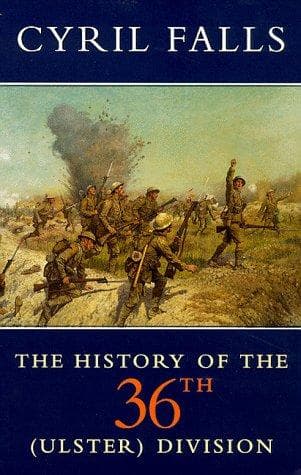
The History of the 36th (Ulster) DivisionFalls, Cyril
History
The History of the 36th (Ulster) Division
Falls, Cyril
Great Britain. Army. Division, 36th; World War, 1914-1918 -- Regimental histories -- Great Britain
General Ricardo returned at this time to England. The strain of the
Battle of Cambrai and the counter-offensive had told severely upon
his health. Except for a few weeks when he commanded another Brigade,
he had been with the 36th Division from the beginning, had indeed,
as has been elsewhere recorded, assisted at its birth. His brilliant
powers of organization and his concentration upon the whole aspect of
any problem presented to him, made him an ideal Brigadier in what has
been described as a war of material. He was succeeded by his friend
and brother-officer of the Inniskilling Fusiliers, Brigadier-General
W. F. Hessey, D.S.O. General Hessey also had been one of the original
commanding officers of the 109th Brigade, and had come to France with
the 11th Inniskillings, leaving that battalion to command a brigade
before the opening of the Somme battle. General Ricardo's organizing
abilities were not lost to the British Army. He ended the war as
Commandant of the large base of Dieppe.
The lessons of the Battle of Cambrai are clear enough, though some
of its aspects will remain mysterious till all the secrets of the
war are revealed. The piercing of the Hindenburg fortifications
was to a certain extent a gamble, since no such operation had yet
been attempted in such manner. The very fact that its surprise was
complete was perhaps the most remarkable feat of all. It was a
triumphant success, though it must be remembered that the Germans
were ill equipped with either armour-piercing ammunition or anti-tank
guns to oppose it. But, if the break-through was wonderfully
achieved, the ensuing exploitation was not. The resistance of
Flesquières and a broken bridge at Masnières checked the cavalry in
its eastward thrust, but, after all, the Canal de l'Escaut was won,
and exploitation east of it, including the capture of Cambrai, was
of less importance than the northern advance to the Sensée marshes.
"Cambrai," the writer heard a distinguished soldier say, "was either
a surprise or it was not. It opened as a surprise, but it was not
continued as a surprise should be." It appears probable to-day that
had two fresh Divisions been passed through after the troops had
reached their objectives--disregarding Flesquières, which actually
did very little harm--they could have been firmly consolidated on the
Bourlon Ridge by next morning, and possibly reached the outskirts of
Cambrai. Mœuvres likewise would probably not have been a hard nut
for the teeth of one of the reserve Brigades of the 36th Division
that afternoon. As it was, these troops on that first day sat in the
rain and were not employed. The supreme difficulty, which was not
surmounted, was the passing through of new formations in a fresh
state. This difficulty was due to the scanty accommodation in the
forward area, which could not be largely augmented without robbing
the attack of one of its most essential features--surprise. It was
probably this cause which kept the Divisions in the V. Corps so far
Public-domain text, read in full here on John Shaqi.
Reviews
Reviews
No reviews yet
Be the first to share your thoughts on this work.
Elsewhere in the archive
Join the Discussion
Join the discussion
Sign in to leave a comment or review.
Sign InorCreate an account