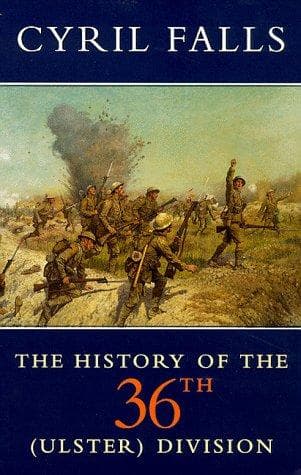
The History of the 36th (Ulster) DivisionFalls, Cyril
History
The History of the 36th (Ulster) Division
Falls, Cyril
Great Britain. Army. Division, 36th; World War, 1914-1918 -- Regimental histories -- Great Britain
For the moment--a fleeting moment, indeed--the enemy had second place
in the minds of officers and men of the Division. Its first concern
was with its reorganization. The shortage of man-power had been
talked of long enough. Its fruits had now to be plucked, and bitter
they were. The whole British Army was now cutting down its divisions
to nine infantry battalions, and its brigades to three. From the
tactical point of view, apart from the fact that it entailed a loss
of some hundred and seventy-five battalions, the change had serious
inconveniences. The brigade of four battalions was the traditional
British formation, just as the regiment of three was the Continental.
It was the formation which British commanders had handled in training
and practice, upon which their conceptions of infantry in war were
based. The moral loss was no less great, particularly in divisions
and brigades with strong territorial associations and sentiment.
It meant that battalions in every division disappeared, and that
either their personnel was transferred to others, or that they became
"Entrenching Battalions," pitiful, nameless ghosts, robbed of their
pride and their traditions. Such changes could not be without their
effect upon moral, working through the loss of _esprit-de-corps_, the
very life's blood of a combatant unit.
[Illustration: VICTORIA CROSSES OF THE 36^{th} (Ulster)
DIVISION--1917 and 1918.
The late 2/Lt. E. DE WIND
15^{th} Royal Irish Rifles.
The late Corp. E. SEAMAN
2^{nd} Royal Inniskilling Fusiliers.
2/Lt. C. L. KNOX
Royal Engineers.
Pte. N. HARVEY
1^{st} Royal Inniskilling Fusiliers.]
The 36th Division, it will be remembered, had already received two
regular battalions, the 2nd Royal Irish Rifles and the 1st Royal
Irish Fusiliers. It was now joined by three more, the 1st and 2nd
Royal Inniskilling Fusiliers, from the 29th and 32nd Divisions
respectively, and the 1st Royal Irish Rifles, from the 8th Division.
To make place for them, the 10th and 11th Inniskillings, the 8th/9th,
10th, and 11th/13th Rifles had to disappear. Three Entrenching
Battalions, the 21st, 22nd, and 23rd, were formed from the disbanded
battalions after the remainder, including the newcomers, had been
brought up to strength. The 2nd Rifles in the 108th Brigade, and the
1st Irish Fusiliers in the 107th, were exchanged. The infantry of the
Division was now as follows:
107TH INFANTRY BRIGADE.
1st Royal Irish Rifles.
2nd Royal Irish Rifles.
15th Royal Irish Rifles.
108TH INFANTRY BRIGADE.
12th Royal Irish Rifles.
1st Royal Irish Fusiliers.
9th Royal Irish Fusiliers.
109TH INFANTRY BRIGADE.
1st Royal Inniskilling Fusiliers.
2nd Royal Inniskilling Fusiliers.
9th Royal Inniskilling Fusiliers.
Public-domain text, read in full here on John Shaqi.
Reviews
Reviews
No reviews yet
Be the first to share your thoughts on this work.
Elsewhere in the archive
Join the Discussion
Join the discussion
Sign in to leave a comment or review.
Sign InorCreate an account