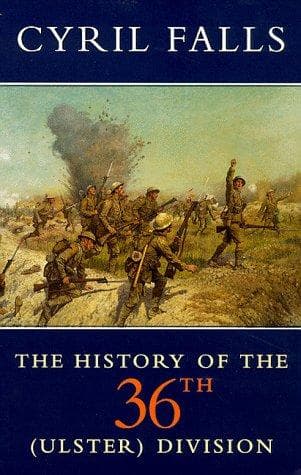
The History of the 36th (Ulster) DivisionFalls, Cyril
History
The History of the 36th (Ulster) Division
Falls, Cyril
Great Britain. Army. Division, 36th; World War, 1914-1918 -- Regimental histories -- Great Britain
Reliefs of French by British formations always presented great
difficulties, owing to the fact that reserves of munitions of every
sort had to be transferred, instead of being simply handed over as
when Briton relieved Briton. Differences of language and of method
were scarcely less important. Yet it often happened that reliefs on
such occasions were the most satisfactory of all. Each side was on
its mettle. Staff work was meticulously careful, reconnaissances
were thorough, guides of proved intelligence chosen. This case was
no exception. There is hardly a diary of the formations and units
of the 36th Division in which is not expressed high appreciation of
the arrangements made by the French, and of the kindness with which
advance parties were treated by them. One officer writes of his own
reception by a French regimental commander: "The most amazing dinner
I ever did have in the line! We had course after course of wonderful
things, with suitable wines, till it was hard to think that the Huns
could be only a thousand yards distant, but that was all they were."
And not the officers only were entertained, for his men informed him
that "the _poilus_ made them eat the whole time and absolutely bathed
them in coffee."
The front taken over ran from Sphinx Wood, some twelve hundred
yards west of the village of Itancourt, to a point on the St.
Quentin-Roisel Railway a thousand yards west of Rocourt Station.
Rocourt is a suburb of the city of St. Quentin, at the gates of
which the British Armies now sat. The position and its defences
will have to be described later in some detail. Here it need only
be said that the latter were already considerable, but that, the
relief taking place in the midst of a thaw following upon weeks of
snow and frost, the 36th Division succeeded to a legacy of fallen-in
trenches and mud. For the rest, it was on the whole a quiet front and
not uncomfortable. The destruction of the villages behind our lines
did not appear to be as complete as before Cambrai. A few French
civilians had trickled back to villages such as Ollézy and Douchy,
while the town of Ham, where were the Headquarters of the XVIII.
Corps, was intact and was full of them.
The Germans, who had excellent observation, were, of course, quickly
aware of the relief, and evidently received orders to obtain
identifications of the new troops in front of them. After several
fruitless attempts they succeeded in obtaining them. On the night
of January the 22nd they entered our outpost line on the front of
both Brigades, capturing in each case a wounded prisoner. A small
patrol of the 10th Rifles was also waylaid by superior numbers, and
an officer and sergeant taken. This appeared to content them, and
thereafter, for a considerable time, the front became of a placidity
such as the troops of the 36th Division had seldom known.
Public-domain text, read in full here on John Shaqi.
Reviews
Reviews
No reviews yet
Be the first to share your thoughts on this work.
Elsewhere in the archive
Join the Discussion
Join the discussion
Sign in to leave a comment or review.
Sign InorCreate an account