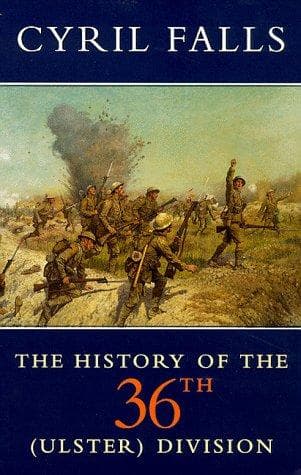
The History of the 36th (Ulster) DivisionFalls, Cyril
History
The History of the 36th (Ulster) Division
Falls, Cyril
Great Britain. Army. Division, 36th; World War, 1914-1918 -- Regimental histories -- Great Britain
The Battle of Cambrai had been the last fling of the Allies for the
time being. They were now definitely upon the defensive, awaiting a
great attack in some uncertainty as to the precise point at which it
should be launched. The victories of the Central Powers upon other
fronts, above all the collapse of Russia, had freed German troops
which, if not for the most part of high quality, would be able to
man defences while attack was delivered elsewhere by the superior
troops they relieved. Not a week passed without the announcement of
the arrival of new divisions from Russia or Italy. Between November
the 1st, 1917, and March the 20th, 1918, the number of German
divisions in the Western theatre had increased from one hundred and
forty-six to one hundred and ninety-two.[49] The total continued to
grow for some time after the launching of the offensive. The heavy
artillery had also been greatly increased, while a number of Austrian
artillery regiments had come to the aid of their allies. The forces
of the Allies were now considerably outnumbered, though not nearly
to the extent which many writers, then and since, have pretended.
Moreover, they were without unity of command, and there was among
them divided opinion as to the point at which they would have to meet
the onslaught, though Sir Henry Wilson had insisted that it would be
at the junction of British and French. There had been preparations
for an advance in Flanders. The French had apprehensions of one in
Champagne. On both these fronts there came, indeed, great attacks
at subsequent dates. Even if the attack were to come, as seemed
most probable, on the front of General Gough's Fifth and General
Byng's Third Armies, its exact scope was uncertain. The final opinion
appeared to be that, while the opening assault would extend further
south, the main weight of the attack would be north of the Somme,
along which would be formed a defensive flank. There is little doubt,
from the writings of German staff officers since published, that such
was the original intention, and that only unexpectedly great success
south of the Somme induced Ludendorff to modify it. It appears also
that the Crown Prince, in whose Group of Armies were the forces in
the left of the German advance, urged him to adhere to his first plan
even after the battle had been several days in progress.
Public-domain text, read in full here on John Shaqi.
Reviews
Reviews
No reviews yet
Be the first to share your thoughts on this work.
Elsewhere in the archive
Join the Discussion
Join the discussion
Sign in to leave a comment or review.
Sign InorCreate an account