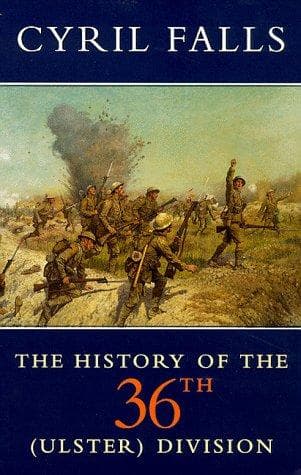
The History of the 36th (Ulster) DivisionFalls, Cyril
History
The History of the 36th (Ulster) Division
Falls, Cyril
Great Britain. Army. Division, 36th; World War, 1914-1918 -- Regimental histories -- Great Britain
Lord Haig in his Despatches has revealed that, not being able to hold
all his extended front in adequate strength, having to take risks
somewhere, he took them on the front of the Fifth Army, where there
was most elbow-room, and where loss of ground was likely to have
least serious effects. It had become more and more apparent that
defence in depth offered the best means of checking and breaking up
an advance, and it had been laid down by G.H.Q. that all preparations
must be based upon that system. Unfortunately, with the slender
forces at the disposal of General Gough, defence in adequate depth
implied a very shadowy defence in breadth.
The system of defence of divisions in line comprised a Forward
Zone and a Battle Zone. The object of the former was to withstand
a minor attack, and to check and, so far as might be, disorganize
and disintegrate a major one. On the Battle Zone the Army Commander
was to oppose the enemy's advance with all the forces at his
disposal. The Forward Zone comprised a front and intermediate system;
the former consisting of outpost line, line of resistance, and
counter-attack companies; the latter of a system of isolated forts,
wired all round, known as the Line of Redoubts. The Battle Zone
likewise consisted of two main lines of defence, organized internally
with counter-attack units and wired-in redoubts. The description
of these defences may sound formidable till it is explained that
there was but one battalion for the defence of each of them to two
thousand yards on the front of the 36th Division, and even less
density further south. There were likewise Rear Zone defences,
notably behind the Canal de St. Quentin and Canal de la Somme. Here
it may be added that confusion has been caused in the minds of many
by the fashion in which the names "Somme River," "Somme Canal," "St.
Quentin Canal," and "Crozat Canal" have been used by various writers
in their descriptions of the battle; because the canalized Somme,
giving birth to different canals at different parts of its course,
was also the main obstacle in two successive lines of defence. The
Somme runs south-west from St. Quentin to St. Simon, west for nine
miles to Voyennes, then more or less due north to Peronne. Over the
first of these three sections it is canalized under the name of the
Canal de St. Quentin; over the second two, under that of the Canal de
la Somme. Where confusion is apt to arise is in the fact that at St.
Simon the Canal de St. Quentin leaves its parent river and runs down
to the Oise at Terguier. In the account that follows, the river, a
winding, branching stream, will be disregarded, and the Canals, which
formed the real obstacles, alluded to always as the Canal de St.
Quentin and Canal de la Somme.[50]
Public-domain text, read in full here on John Shaqi.
Reviews
Reviews
No reviews yet
Be the first to share your thoughts on this work.
Elsewhere in the archive
Join the Discussion
Join the discussion
Sign in to leave a comment or review.
Sign InorCreate an account