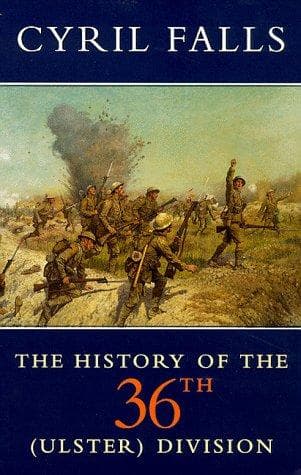
The History of the 36th (Ulster) DivisionFalls, Cyril
History
The History of the 36th (Ulster) Division
Falls, Cyril
Great Britain. Army. Division, 36th; World War, 1914-1918 -- Regimental histories -- Great Britain
The night of February the 22nd, which saw the entry into line of the
30th Division, saw also a reorganization of the system of defence.
All three Brigades now entered the line, the 108th on the right,
107th in the centre, and 109th on the left. Each had one battalion
in the Forward Zone, one as garrison for the Battle Zone, and one in
reserve. In each case the Forward Zone battalion had two companies
in the line of resistance, finding their own outposts, one company
for counter-attack in the front system, and one "passive resistance"
company, with battalion headquarters, in a large fort in the Line of
Redoubts. This unfortunate description implied that the last-named
company was not allowed to counter-attack to retake ground lost in
the front system. The Battle Zone battalions were billeted close
to their battle stations, that of the 108th Brigade in dug-outs at
Essigny Station, along the railway cutting, of the 107th Brigade in
quarries near Grand Séraucourt, and of the 109th at Le Hamel, on
the other side of the St. Quentin Canal. The artillery was disposed
in two groups covering the Forward Zone, with one of the three
Brigades, the 153rd, in reserve as supporting brigade. On February
the 28th, when XVIII. Corps announced a "state of preparation," the
batteries of this brigade took up positions south-east of Grand
Séraucourt to cover the Battle Zone, with a section per battery
pushed forward to temporary positions covering the Line of Redoubts.
Upon these positions a vast amount of work had to be accomplished, an
amount so vast that it permitted of very scanty time being allotted
for training. The Battle Zone had practically to be created. The
lines had been merely sited by the French, and a little wire put up.
Work was concentrated first of all upon this; secondly, upon the
fortresses which were to contain battalion headquarters and "the
passive resistance" company in the Line of Redoubts--known, from
right to left, as "Jeanne d'Arc," "Racecourse," and "Boadicea"; and
lastly, upon making good the main communication trenches, and making
wired-in platoon keeps in the Forward Zone. There was shortage of
wire in February and the early part of March, and bad indeed would
have been the state of the defences but for the large dumps left
behind by the French, for which the countryside was scoured. As it
was, no-one in the 36th Division can be said to have been satisfied
with the state of the Battle Zone by mid-March. Most of the trenches
were no more than eighteen inches deep, it having been ruled that
there would be time to dig them out when it became necessary to
occupy them.
Public-domain text, read in full here on John Shaqi.
Reviews
Reviews
No reviews yet
Be the first to share your thoughts on this work.
Elsewhere in the archive
Join the Discussion
Join the discussion
Sign in to leave a comment or review.
Sign InorCreate an account