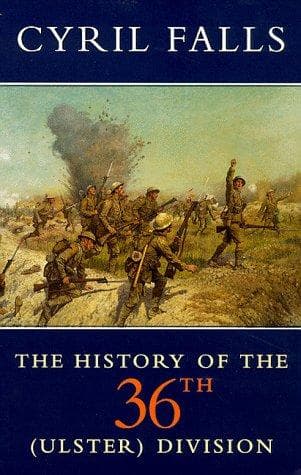
The History of the 36th (Ulster) DivisionFalls, Cyril
History
The History of the 36th (Ulster) Division
Falls, Cyril
Great Britain. Army. Division, 36th; World War, 1914-1918 -- Regimental histories -- Great Britain
Uncanny work it was awaiting, in the silence of quietest of quiet
lines, a mighty attack of which for very long there was scarce
an indication. In the earlier days, save for reports from higher
formations of aerodromes, hospitals, and railways far behind the
German lines, the sole warning sign was in the large numbers of
officers, maps in hand, observing day by day the British trenches
and the country behind them. There was no great increase of movement
on forward roads till about the 12th of March. Aeroplane photographs
taken about this date showed that a large number of shell-holes a few
hundred yards from the outpost line had been worked upon. It was
surmised that these were being prepared for trench mortars, for the
destruction of the British front-line system, as that of the Russians
had been destroyed before the last great German advance at Riga.
Significant also, in this connection, was the fact that Oskar von
Hutier, who had carried out that attack, was now in line opposite, in
command of Eighteenth Army. His known character and antecedents were
food for reflection.
New military roads were also discovered behind Itancourt. But it was
a few clear mornings and evenings, from the 15th of March onwards,
that brought most conclusive evidence of what was impending. From the
dovecote in Essigny, the best observation post on the XVIII. Corps
front, which was manned by the 36th Division's excellent observers,
an enormous amount of traffic could now be observed. Along the main
road from Guise-Mont d'Origny to St. Quentin, in particular, huge
convoys of lorries and horse transport were seen, as dusk drew
in, moving towards the last-named city. Small place for doubt now
remained.
On March the 4th occurred a curious incident. The Germans had
apparently come to the conclusion that the British front line had
been abandoned; and, indeed, it was held lightly enough by isolated
sections. Strong patrols, amounting in general to a platoon, suddenly
issued from the German trenches all along the 36th Division's front,
in broad daylight. The outposts might be weak, but they could resist
an attempt of this sort. Under the fire of Lewis guns all the patrols
were stopped and dispersed with heavy loss. Patrols sent out in turn
from the outpost companies captured in all one officer and ten other
ranks. It was a sharp lesson, and thereafter, till the opening of the
attack, was no move by the German infantry.
Public-domain text, read in full here on John Shaqi.
Reviews
Reviews
No reviews yet
Be the first to share your thoughts on this work.
Elsewhere in the archive
Join the Discussion
Join the discussion
Sign in to leave a comment or review.
Sign InorCreate an account