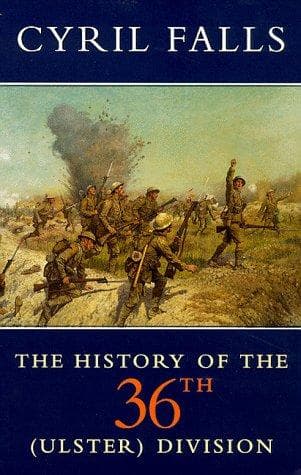
The History of the 36th (Ulster) DivisionFalls, Cyril
History
The History of the 36th (Ulster) Division
Falls, Cyril
Great Britain. Army. Division, 36th; World War, 1914-1918 -- Regimental histories -- Great Britain
The artillery had begun moving a large proportion of its guns to new
positions on the night of the 17th, having taken a hint from the fate
of batteries on the front of the Third Army, which had just been
subjected to the heaviest "mustard" gas bombardments experienced in
the whole course of the war. The moves of batteries of the 173rd
Brigade were actually not complete till a few hours prior to the
launching of the attack. The dispositions were then as follows:
RIGHT GROUP. (Covering front of 108th and 107th Infantry Brigades.)[51]
Headquarters, 173rd Brigade, R.F.A.
"A," "B," "C," and "D" Batteries, 173rd Brigade, R.F.A.
462nd Battery, R.F.A.
464th Battery, R.F.A.
LEFT GROUP. (Covering front of 109th Infantry Brigade.)
Headquarters, 179th Army Brigade, R.F.A.
383rd Battery, R.F.A.
463rd Battery, R.F.A.
"D" Battery, 232nd Brigade, R.F.A.
BATTLE ZONE GROUP.
Headquarters, 153rd Brigade, R.F.A.
"A," "B," "C," and "D" Batteries, 153rd Brigade, R.F.A.
With one great crash there opened a tremendous bombardment, of trench
mortars by the hundred and every calibre of artillery save the 77-mm.
field gun. Its continuous roar was punctuated, to those a little
distance from the line, by the explosions of huge single shells
upon objectives in rear. So far as can be ascertained the German
programme consisted of a concentration mainly of trench mortars on
the front system; a bombardment with high explosive and phosgene
gas of the Line of Redoubts, the valley in rear of it, the trenches
of the Battle Zone, and Battery Valley, which ran behind its ridge;
for which 105, 150, and 210-mm. howitzers were employed; and fire on
villages in rear, and upon the crossings of the Canal de St. Quentin,
with the largest howitzers and high-velocity guns. Particularly
heavy fire was directed upon the redoubts and battery positions. The
proportion of lethal shell to high-explosive gradually decreased,
till the barrages were composed entirely of the latter. There was,
according to the reports of artillerymen, a remarkable absence of
77-mm. shell and of instantaneous fuses.
Five minutes after the opening of the bombardment the order, "Man
Battle Stations," was sent out by the General Staff. Dawn had broken
in a dense mist. Morning mists at this season and in this district
are the rule rather than the exception, but this was far thicker than
the ordinary. It was at five o'clock impossible to see more than ten
yards ahead, and visibility increased very slowly till the afternoon.
All the battalions in the Battle Zone appear to have reached their
stations, upon ground thoroughly known to officers and men, in good
time, but, as communications were constantly cut and runners were
slow amidst the fog and the shelling, reports were long in coming
to hand. This loss of telephone communication rendered it almost
impossible to issue barrage orders to the artillery.
Public-domain text, read in full here on John Shaqi.
Reviews
Reviews
No reviews yet
Be the first to share your thoughts on this work.
Elsewhere in the archive
Join the Discussion
Join the discussion
Sign in to leave a comment or review.
Sign InorCreate an account