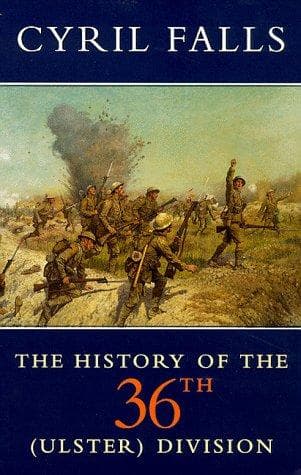
The History of the 36th (Ulster) DivisionFalls, Cyril
History
The History of the 36th (Ulster) Division
Falls, Cyril
Great Britain. Army. Division, 36th; World War, 1914-1918 -- Regimental histories -- Great Britain
From March the 12th onward was instituted a series of nightly
bombardments, in which the now considerable heavy artillery at the
disposal of the XVIII. Corps took part, of valleys and dead ground
forming probable assembly positions. Tests of the action to follow
the preconcerted Corps message, "Man Battle Stations," were carried
out. Bridges had long been prepared for demolition and allotted to
particular sections of the Field Companies. Small mine-fields had
been constructed in case of the employment of tanks by the enemy.
Grugies Valley was starred with machine-guns, to sweep its length
with zones of flanking fire. It was felt by officers and men of the
Division that what the limited means at its disposal permitted had
been accomplished. The worst misgivings were with regard to the gaps
between keeps and redoubts in the Forward Zone, owing to the paucity
of numbers available for its defence. There was no touch between the
battalion headquarters forts in the Line of Redoubts; they were in no
sense mutually supporting. There was little to prevent the enemy from
breaking through in the intervals, pushing forward his main advance
almost unembarrassed by them, while special detachments swallowed
them at leisure.
Much noise of enemy traffic was heard at night from the 17th onward.
On the evening of the 18th two Germans entered our lines on the front
of the 107th Brigade to give themselves up. They declared they had
deserted to avoid the coming battle, which would not now be long
delayed. They confirmed the suspicions of massed trench mortars on
the front. They had seen great numbers of troops, particularly of
artillery. St. Quentin, they said, was packed with men. On the night
of the 20th a raid was carried out by the 61st Division, resulting
in the capture of prisoners who stated that the attack was to be
launched the following morning. A special bombardment was therefore
carried out from 2-30 to 3 a.m., with heavy rolling barrages on
likely positions of assembly.
The great moment, for which, it is scarce exaggeration to say, men
were waiting all the world over, came at 4-35 a.m. on the morning of
March the 21st. The infantry of the 36th Division was then disposed
as follows:
RIGHT BRIGADE: 108TH BRIGADE.
Forward Zone: 12th Rifles.
Battle Zone: 1st Irish Fusiliers.
Divisional Reserve: 9th Irish Fusiliers.
CENTRE BRIGADE: 107TH BRIGADE.
Forward Zone: 15th Rifles.
Battle Zone: 1st Rifles.
Divisional Reserve: 2nd Rifles.
LEFT BRIGADE: 109TH BRIGADE.
Forward Zone: 2nd Inniskillings.
Battle Zone: 1st Inniskillings.
Divisional Reserve: 9th Inniskillings.
Public-domain text, read in full here on John Shaqi.
Reviews
Reviews
No reviews yet
Be the first to share your thoughts on this work.
Elsewhere in the archive
Join the Discussion
Join the discussion
Sign in to leave a comment or review.
Sign InorCreate an account