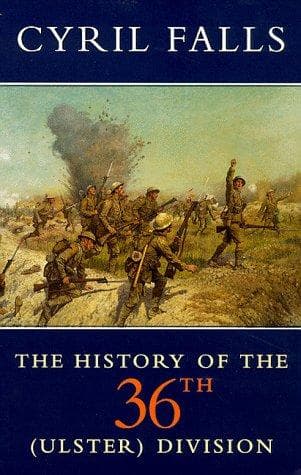
The History of the 36th (Ulster) DivisionFalls, Cyril
History
The History of the 36th (Ulster) Division
Falls, Cyril
Great Britain. Army. Division, 36th; World War, 1914-1918 -- Regimental histories -- Great Britain
An hour later the fog suddenly lifted. It was then clear to "C"
company what progress the enemy had made. More than a mile to rear
the Germans could be seen swarming about Jeanne d'Arc Redoubt, which
held the battalion headquarters and "B" company. On the front of the
14th Division German cavalry could be seen advancing, and, what was
even more astonishing, a column of transport, three hundred yards
long, moving down the main St. Quentin-La Fère Road, about four
hundred yards to the right of "C" company's position. Lewis-gun fire
opened upon this body in a few seconds killed or wounded every man
and horse in it, leaving the whole column in a welter of confusion.
By now, however, the company was being attacked from both flanks,
and a withdrawal to Lejeune Trench, five hundred yards in rear, was
ordered. The enemy followed up the withdrawal fiercely and with
the greatest gallantry, a rather pathetic incident occurring when a
single German with bayonet fixed charged the whole line! The incident
is instructive, as it reveals the high state of training in the
offensive spirit of the attacking troops, and helps to account for
some of their successes in later days, when our men were wearied out.
"C" company, reinforced by the forward headquarters, which had been
in Le Pontchu Quarry, now numbered nearly a hundred and twenty men. A
further magnificent stand was here made.
About 3 p.m. a company of the enemy, evidently believing they had
to deal with but a handful, was seen marching up in fours from the
rear. The men held their fire till the Germans reached point-blank
range. Then such a blast burst forth as brought the whole body to the
ground. Captain Johnston believes that not a man escaped.
The position, however, was now hopeless. All thought of cutting a way
through was out of the question, so thick were the enemy to rear.
The end came at 4 p.m. A German tank came down the main road, firing
into the trench in enfilade. At the same moment a whole battalion
advanced from the front. There were about a hundred men only alive,
many of them wounded. There was no course open but surrender. As the
prisoners were marched back toward St. Quentin they had the grim
satisfaction of seeing the column of transport they had annihilated
still strewn in indescribable confusion about the road.
This most valorous defence was, as has been stated, unknown at the
time. After the Armistice one Military Cross, two Distinguished
Conduct Medals, and four Military Medals were awarded to the
survivors of the company. The defence of "C" company of the 12th
Rifles, against hopeless odds, when all seemed melting about them,
must be held to rank with the very finest episodes of that month
of March, the blackness of which is gilded with so many deeds of
imperishable courage and fortitude.
Public-domain text, read in full here on John Shaqi.
Reviews
Reviews
No reviews yet
Be the first to share your thoughts on this work.
Elsewhere in the archive
Join the Discussion
Join the discussion
Sign in to leave a comment or review.
Sign InorCreate an account