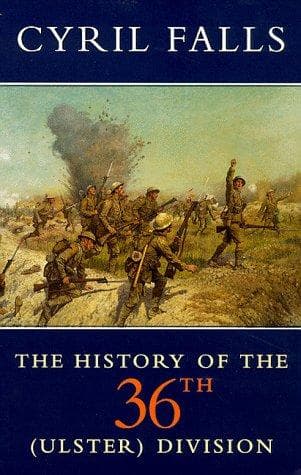
The History of the 36th (Ulster) DivisionFalls, Cyril
History
The History of the 36th (Ulster) Division
Falls, Cyril
Great Britain. Army. Division, 36th; World War, 1914-1918 -- Regimental histories -- Great Britain
Ricardo Redoubt, in which the heroic resistance of Colonel Crawford's
1st Inniskillings continued all day, was now, of course, completely
isolated. At three o'clock the commanding officer sent away a
detachment, some men of which succeeded in making their way back to
our lines. The remainder fought to the end. Finally driven to the
north-western corner of the Redoubt, they ejected the enemy bombers
who had now a footing there. Two men alone, Privates Bailey and
Conway, drove out one group of the German bombers. Trench mortars
pounded them from all sides, which they could not reach. A mere
handful was taken prisoner with Colonel Crawford about 6 p.m. It is
difficult to overestimate the value of this magnificent stand against
overwhelming odds.
The position at two o'clock on the morning of March the 23rd may be
summarized for the sake of clarity. The 36th Division, with attached
troops, held the line of the Canal de St. Quentin and Canal de la
Somme from a mile and a half north-west of Jussy to a mile west of
Sommette-Eaucourt. Upon this line it had, from right to left, the
61st Brigade (7th Somerset L.I. on right, 7th D.C.L.I. on left, 12th
King's in support); the 108th Brigade (9th Irish Fusiliers on right,
1st Irish Fusiliers on left; with a composite battalion of details
and men returned from courses finding the outposts, to allow some
rest to the other battalions); 21st Entrenching Battalion. The length
of the front was upwards of five miles. The 16th Rifles (Pioneers)
was at Sommette-Eaucourt, where the battalion had been working
since before noon on a line of strong points. The 109th Brigade,
consisting now of the 9th Inniskillings, was at Brouchy, in reserve.
The 107th Brigade Headquarters and the 2nd Irish Rifles were at
Cugny. The other battalion of this Brigade, the 1st Rifles, now very
weak, was at Eaucourt. Divisional Headquarters were at Fréniches.
The artillery position is somewhat complicated, owing to early losses
and subsequent changes. The Potter Group (A/153rd Brigade R.F.A.;
B/153rd Brigade R.F.A.; D/173rd Brigade R.F.A.; D/91st Brigade
R.F.A.; and 383rd Battery R.F.A.) had been ordered to join the 20th
Division. It was in action in Bacquencourt during the day, rejoining
the 36th Division in the afternoon after a big march. The front was
now covered by the Erskine Group (A/91st and C/91st Brigade R.F.A.;
and D/173rd Brigade R.F.A.) on the right, in positions in and around
Aubigny; and the Eley Group (463rd and 464th Batteries R.F.A.;
C/153rd and D/153rd Brigade R.F.A,; B/91st Brigade R.F.A.; and two
howitzers of B/232nd Army F.A. Brigade) on the left, in positions
near Brouchy. The Heavy Artillery Group was out of touch, and could
no longer cover the divisional front.
The Machine-Gun Battalion had disappeared as a unit, but there were
still detachments with each of the Brigades, acting as a rule under
the orders of the battalion commander on the spot.
Public-domain text, read in full here on John Shaqi.
Reviews
Reviews
No reviews yet
Be the first to share your thoughts on this work.
Elsewhere in the archive
Join the Discussion
Join the discussion
Sign in to leave a comment or review.
Sign InorCreate an account