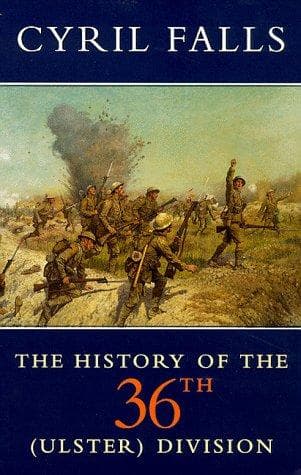
The History of the 36th (Ulster) DivisionFalls, Cyril
History
The History of the 36th (Ulster) Division
Falls, Cyril
Great Britain. Army. Division, 36th; World War, 1914-1918 -- Regimental histories -- Great Britain
In the account which follows, it is scarcely to be hoped that
all the confusion arising from reports that often conflicted can
be eliminated. The resistance made by the 36th Division and its
attached troops was one in which a large number of units, some
existing, some hastily improvised, took part. But, for the most
part, they were very small units, except for the battalions of the
61st Brigade, less depleted and less wearied by the morning of March
the 23rd than those of the 36th Division. This chapter opens with
events occurring forty-eight hours after the beginning of the great
German bombardment. In that period the troops of the Division had
been constantly engaged in fighting, or, when not fighting, on the
march, or upon the alert for a fresh attack. On the nights neither
of the 21st nor the 22nd had more than a couple of hours' sleep
been snatched by any of the infantry. Many units had had absolutely
none. The men were already wearied out. The 1st Rifles, to take one
example, after fighting all day on the 22nd in the neighbourhood,
first of Le Hamel, then of Happencourt, had marched by night to
Pithon, there crossed the Canal de la Somme, then continued its march
to Eaucourt, which was reached at three in the morning. The distance
covered was nine miles. Even on arrival there was not rest for all,
as piquets had to be posted round the village.
It is hard for those who have not seen a great retreat of this nature
to imagine how depressing are the circumstances and the sights which
he sees about him to the soldier entrusted with the fighting of
delaying actions, how great his mental and moral, apart altogether
from his physical, strain. The flood of civilians pouring out of
towns and villages was in itself a pathetic and depressing sight. At
three o'clock on the afternoon of the 22nd the nurses of the C.C.S.
in Ham were walking down the Guiscard Road, carrying bundles, some
of them assisting wounded men. Lorries and ambulances had already
taken the worst cases, but at this stage there was not transport
enough for all. Such sights as these were calculated to prey upon the
mind and react upon the moral of the stoutest hearted. Allied with
great physical fatigue and the sensation of being three or four times
outnumbered, their effect was even more dangerous.
The exploits of the troops of the Fifth Army are great enough without
straining the note. Some writers had made it appear as though the
men were of triple brass. Men are of less durable material. Each
has what may be called his "weakening-point," which is arrived at
sooner in some men than in others. There were cases of weakness in
the days that followed among troops of the 36th Division, as among
other troops. But their achievements must be measured by the standard
of their cruel and heart-breaking task. With that as gauge, these
achievements, viewed as a whole, stand out in their magnificence, a
shining monument to the spirit of the race that bred them.
Public-domain text, read in full here on John Shaqi.
Reviews
Reviews
No reviews yet
Be the first to share your thoughts on this work.
Elsewhere in the archive
Join the Discussion
Join the discussion
Sign in to leave a comment or review.
Sign InorCreate an account