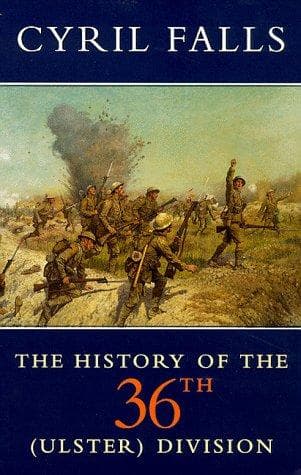
The History of the 36th (Ulster) DivisionFalls, Cyril
History
The History of the 36th (Ulster) Division
Falls, Cyril
Great Britain. Army. Division, 36th; World War, 1914-1918 -- Regimental histories -- Great Britain
It was, however, discovered at dawn that parties of Germans had
entered Golancourt in the darkness, and that our men had evacuated
the village. This was a very serious blow, as it threw into confusion
schemes formulated overnight between General Hessey, commanding the
109th Brigade, and General Cochrane, commanding the 61st. These two
commanders had planned a counter-offensive to ease the pressure on
the left flank, and blunt the pronounced salient into which the line
was being forced. General Nugent had put at General Hessey's disposal
a composite battalion under Major Knox, and had later strengthened
his line by sending up three hundred details from Beaulieu, servants,
orderlies, grooms from Headquarters, and the personnel of the Signal
School. These were formed into two companies, under the command of
Captain W. Smyth, R.E., attached to the General Staff, and Captain
C. Drummond, A.D.C. to General Nugent. Major Knox's detachment was
to move _via_ Golancourt, approach Aubigny as closely as might be in
the mist, and attack the village at eight o'clock. Meanwhile the 9th
Inniskillings, with a company of details, was to reoccupy Brouchy.
General Cochrane arranged to retake Eaucourt with a hundred men of
the 284th Army Troops Company, R.E., who had come under his orders,
commanded by two of his own infantry officers. This he had succeeded
in doing before midnight on the 23rd. Touch was obtained by the
attacking force with the 7th D.C.L.I., on the railway where crossed
by the Ollézy-Eaucourt Road.
But Major Knox came under heavy machine-gun fire from Golancourt on
his march, and was unable to make headway. The attacks upon Aubigny
and Brouchy were therefore cancelled, and the companies of details
thrown in on the left of the 9th Inniskillings. The position of the
7th D.C.L.I. on the railway was now impossible. The battalion was
being pressed on either flank, and its right was in air. At eleven
o'clock General Cochrane ordered it to fall back from the railway,
and to take up a line in touch with the fragments of the 12th
King's, a thousand yards west of Cugny, roughly parallel with the
Cugny-Eaucourt Road. The right company of the D.C.L.I. had to fight a
rearguard action to cover the withdrawal, and suffered considerable
loss from machine-gun fire. Upon its heels the Germans pushed forward
their machine-guns and a number of single field guns which had been
brought across the Canal.
Public-domain text, read in full here on John Shaqi.
Reviews
Reviews
No reviews yet
Be the first to share your thoughts on this work.
Elsewhere in the archive
Join the Discussion
Join the discussion
Sign in to leave a comment or review.
Sign InorCreate an account