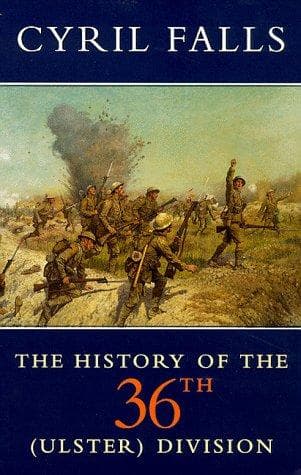
The History of the 36th (Ulster) DivisionFalls, Cyril
History
The History of the 36th (Ulster) Division
Falls, Cyril
Great Britain. Army. Division, 36th; World War, 1914-1918 -- Regimental histories -- Great Britain
In the course of the day all arms of the Division had been constantly
in action. The 16th Rifles, which had been put at the disposal of the
officer commanding the 9th Irish Fusiliers, had been fighting all
day upon the Somme, and had fallen back in the general withdrawal
on the left flank. Details of the Machine-Gun Battalion, under the
second-in-command, Major Low, had, as has previously been recorded,
also been in action on the left. All details, men returning from
courses and leave, had been pushed into the battle. The clerks and
runners of the 109th Brigade Headquarters had fought at Brouchy.
Great steadiness and devotion to duty had been shown by the
Artillery. Two batteries of the 91st Brigade (from the 20th
Divisional Artillery), A/91st and C/91st, are specially mentioned in
the report of the C.R.A. When infantry, in the first case that of
the 109th Brigade, in the second that of the 61st Brigade, fell back
upon their positions, the battery officers rallied the men, and the
gunners aided them to dig in in front of the guns.
Amid all the confusion food supplies had not failed, though no
rations could be distributed to the troops in line till the small
hours of the morning of March the 24th. The 107th Brigade was able,
besides keeping its own troops supplied with tools for entrenching,
to send a number of picks and shovels to Rifle Brigade battalions
of the 14th Division in the neighbourhood of Cugny. On this day
and throughout the retreat the work of the Train and Supply Column
was most praiseworthy, while the Staff Captains of Brigades showed
forethought in their arrangements. The medical services, under great
difficulties, had done all that was possible in the evacuation of
wounded.
The night passed fairly quietly. It was doubtless employed by the
Germans to bring up fresh guns, for upon the morrow the volume of
artillery fire was noticeably greater. There was no German infantry
attack with the light, as might have been expected, on the morning of
March the 24th. It did not come on either flank in any strength till
about ten o'clock. Very probably the enemy had been relieving his
front-line battalions, and their successors were not ready to renew
the struggle till some hours after dawn.
Public-domain text, read in full here on John Shaqi.
Reviews
Reviews
No reviews yet
Be the first to share your thoughts on this work.
Elsewhere in the archive
Join the Discussion
Join the discussion
Sign in to leave a comment or review.
Sign InorCreate an account