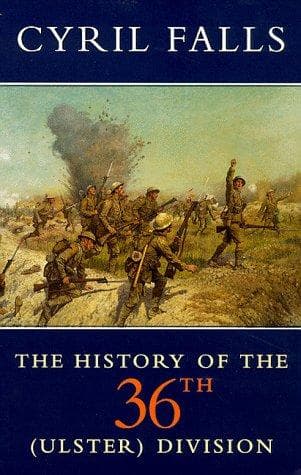
The History of the 36th (Ulster) DivisionFalls, Cyril
History
The History of the 36th (Ulster) Division
Falls, Cyril
Great Britain. Army. Division, 36th; World War, 1914-1918 -- Regimental histories -- Great Britain
Meanwhile upon the right had been enacted a drama truly heroic
which has never been recorded, because, in the days when reports
and despatches were written, there was no survivor to tell its
story. On the morning of the 24th, the 2nd Rifles consisted of the
following officers: Captain T. Y. Thompson, D.S.O., commanding since
the officer commanding at the outset of the attack, Major Rose,
had been wounded; Captain J. C. Bryans, Lieutenant M. E. Y. Moore,
M.C.; Lieutenant R. B. Marriott Watson, M.C.; Lieutenant J. K.
Boyle, M.C.; Lieutenant E. C. Strohm; and perhaps two hundred other
ranks. Of these, Lieutenants Moore and Marriott Watson were old
companions-in-arms. They had served together in the 13th Rifles; had
together taken part in that battalion's great raid on June the 26th,
1916, and had both been wounded on July the 1st. Having withdrawn
from the eastern to the western skirts of Cugny overnight, the
battalion had steadfastly maintained its position, almost entirely
unsupported. After beating off an enemy attack at ten in the morning,
it was discovered that ammunition was woefully short, and orders were
issued to fire at especially good targets only. Captain Thompson,
deliberately exposing himself to encourage the men on the menaced
right flank, which was being again attacked, was killed, as also was
Lieutenant Marriott Watson. Captain Bryans now assumed command.
Messages sent up from the 1st Rifles in rear, ordering the battalion
to withdraw, did not reach it. The men who bore them were killed
or wounded. In any case, it was the opinion of Captain Bryans that
a retirement across the bare, open country between Cugny and the
village of Villeselve, with the Germans on three sides of him, was
impossible.
From noon onwards was a lull, which was occupied in reorganization
of the line. Then, about 2 p.m., preceded by a violent barrage
of artillery and machine-gun fire, supported by an attack from
low-flying aeroplanes, an assault was launched, the Germans sweeping
in from the left in overwhelming numbers, despite the gaps cut in
their ranks by fire. By the time the enemy was upon them there was
scarce a round left to fire. "Many," writes Captain Bryans, "had
only their bayonets left. Rather than wait for the end, they jumped
from the entrenchments and met it gallantly. It was an unforgettable
sight. We were overwhelmed, but not disgraced."
After a desperate hand-to-hand fight, the little band was simply
engulfed. Lieutenants Moore and Boyle were killed. Of about a hundred
and fifty men on their feet when the attack began, it is estimated
that over a hundred were killed or wounded.
Public-domain text, read in full here on John Shaqi.
Reviews
Reviews
No reviews yet
Be the first to share your thoughts on this work.
Elsewhere in the archive
Join the Discussion
Join the discussion
Sign in to leave a comment or review.
Sign InorCreate an account