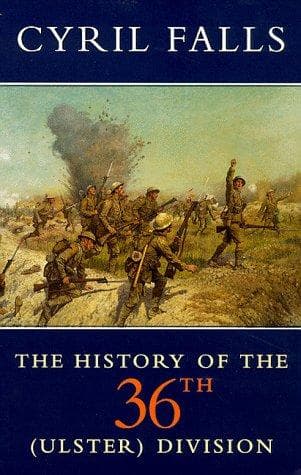
The History of the 36th (Ulster) DivisionFalls, Cyril
History
The History of the 36th (Ulster) Division
Falls, Cyril
Great Britain. Army. Division, 36th; World War, 1914-1918 -- Regimental histories -- Great Britain
But, if the defence was overwhelmed by superior numbers, it seems
clear that it broke down earlier than it need have done, and that
the fault lay in its organization. The Forward Zone was little more
than a screen, and was so regarded. Yet it was held by three whole
battalions on the front of each Division. The orders were that the
enclosed keeps, even in the front system, were to resist to the
last. The whole position in front of the Battle Zone may be regarded
as the outpost line. This outpost line, manned by a third of the
infantry force of each Division, was not to retire and was not to
be reinforced. The first shock of the attack swept this third away.
It was defence in detail, not defence in depth, and in detail it
was defeated. Defence in depth may be defined as successive lines
of organized defence, upon which the defenders can fall back in
succession, always finding some fresh troops on the new position,
so that the line becomes gradually stronger as it falls back, until
at last is reached the line upon which the real defence is to be
made. Gallantly as they strove, much as they accomplished, the three
battalions in the Forward Zone of the 36th Division were wasted under
the Fifth Army scheme.
As for the lines of the St. Quentin and Somme Canals, which might
have been very formidable, there had been no preliminary organization
of their defence, nor even reconnaissance with that end in view. When
the moment came the defence had to be improvised.
[Illustration: Map VI.
The Retreat of March, 1918.]
This does not detract from, but rather increases, the
magnificence of the defence of the 36th Division, and indeed of the
whole of the XVIII. Corps, which had sixteen German Divisions, in
front and second line, against its four. There is at least every
reason to suppose that, had all gone elsewhere as on the front of the
XVIII. Corps, the full weight of reinforcements would have arrived
before the enemy had forced the lines of the St. Quentin and Somme
Canals. In that case the war would undoubtedly have had a speedier
ending.
FOOTNOTES:
[52] These men were evidently advancing from
Saulchoy-sur-Davenescourt, into which a number of the enemy had
filtered in the darkness.
[53] Returned prisoners of war informed Captain Miller, whose diary
has been drawn upon in this chapter, that the streets of Erches,
through which they were marched, were littered with German dead.
So, as he remarks in a letter to the writer, the affair "was not so
one-sided as it looked."
CHAPTER XII
FLANDERS: THE 108TH BRIGADE IN THE MESSINES-KEMMEL BATTLE:[54] APRIL
TO JUNE 1918
Public-domain text, read in full here on John Shaqi.
Reviews
Reviews
No reviews yet
Be the first to share your thoughts on this work.
Elsewhere in the archive
Join the Discussion
Join the discussion
Sign in to leave a comment or review.
Sign InorCreate an account