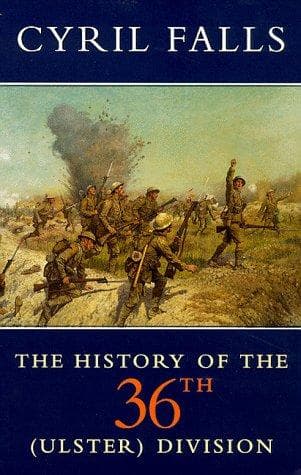
The History of the 36th (Ulster) DivisionFalls, Cyril
History
The History of the 36th (Ulster) Division
Falls, Cyril
Great Britain. Army. Division, 36th; World War, 1914-1918 -- Regimental histories -- Great Britain
The 36th Division had a glance only, infinitely tantalizing, at the
beautiful valley of the Bresle, with its pastures and woodlands,
and snug villages in which the troops were billeted, from Gamaches,
several miles inland, to the little pleasure-resort of Ault on the
coast. A short rest in these surroundings would have been delightful.
But there was no rest for anyone for a long time to come, nor could
be. The last trains did not arrive in the area till the morning of
April the 1st; the last trains left it, bearing the remnants of the
Division towards Ypres, on the 4th. For the old battlefield, still
known as the Salient, was its new destination.
The interval had been spent in reorganization and the absorption of
the Entrenching Battalions, originally formed in February from the
surplus personnel of the infantry, which had accompanied the Division
north. They did not go very far to fill the gaps caused by the
prodigious casualties. The word gaps, in fact, is inapplicable. The
infantry of the Division had disappeared. The 108th Brigade had been
reduced to a little over three hundred, mostly transport and employed
men. The total casualties in the Division in the ten days from March
21st were 7,252. Of these, 185 officers and 5,659 other ranks were
reported missing. Perhaps four-fifths of these were prisoners of war,
wounded or unwounded. It was a very weak Division which detrained at
Proven and other stations further west.
From the day of its arrival, however, it began to receive very
large drafts from the flood of recruits that now poured across the
Channel. Bitter criticisms have been heard of the policy which had
kept so many troops in England till then. Whatever their justice
in some cases, they have none where the drafts now received by the
36th Division are concerned; for of these eighty or ninety per cent.
consisted of boys of nineteen, with far from adequate training. In
some cases these youths, almost before they knew their officers by
sight, were to be put to the severest test, and were to emerge from
it with quite astonishing credit.
Divisional Headquarters, in which Lieutenant-Colonel A. G. Thompson,
D.S.O., Indian Army, had succeeded Colonel Place as G.S.O.1, were
established at Ten Elms Camp, near Poperinghe, on April the 3rd. On
the night of the 6th the Division began relieving the southern part
of the front held by the 1st Division. By the morning of the 8th the
relief was complete, the 107th Brigade being in front line, the 109th
in support, and Divisional Headquarters on the Canal Bank a mile
north of Ypres.[55]
Public-domain text, read in full here on John Shaqi.
Reviews
Reviews
No reviews yet
Be the first to share your thoughts on this work.
Elsewhere in the archive
Join the Discussion
Join the discussion
Sign in to leave a comment or review.
Sign InorCreate an account