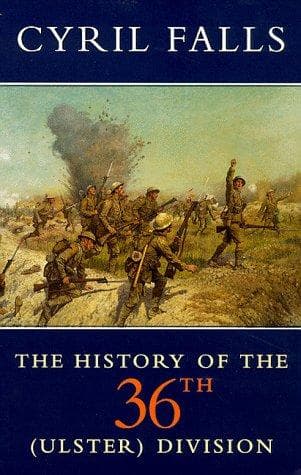
The History of the 36th (Ulster) DivisionFalls, Cyril
History
The History of the 36th (Ulster) Division
Falls, Cyril
Great Britain. Army. Division, 36th; World War, 1914-1918 -- Regimental histories -- Great Britain
The new sector was at the north-west corner of the great salient
made by the Lys offensive. It ran from Fontainehouck, a hamlet
north-east of Meteren, which was in the hands of the enemy, to the
high ground south of the Croix de Poperinghe. It was about a mile
and a half north of Bailleul. Here, as all along the line of hills,
the enemy was at heavy disadvantage. His territory was overlooked.
Every movement, every gun-flash, could be noted from Mont Noir and
the other hills. Bailleul crumbled away before the eyes of our men.
St. Jans Cappel, for so long Divisional Headquarters in days that now
seemed very far away, was not far behind the front line. It was to a
great extent destroyed. Many of the isolated farms, with which that
countryside is bestrewn, were, however, undamaged, right up to the
front line. The country was deep in crops, the wheat having to be cut
round the outposts to prevent surprise attacks and provide a field of
fire. As for vegetables, the men had all the potatoes and green peas
they could eat without walking a hundred yards from where they slept.
After Ypres, it was a very agreeable position. German artillery
fire was not as a rule severe, owing to the fact that the battery
positions were overlooked from the hills. The worst disturbance
was caused by night bombing, assiduously practised by the enemy.
Casualties were low. They would have been lower had our troops been
as circumspect in following the hedges, and confining their movement
to the night, as their predecessors, the French, had been. But the
lesson of "lying low," so well learnt by Frenchman and German, never
had been mastered by the British soldier, nor ever was.
On July the 19th the 9th Division, in line on the right, captured
Meteren, the Artillery of the 36th Division co-operating in the
attack. The 36th Division did not at first strive to improve its
position in a similar way, but contented itself with raids on a large
scale. One, by the 109th Brigade, resulted in very heavy fighting,
the enemy being on the alert. Though the enemy's casualties were
estimated at thirty, and a prisoner was taken, the raid hardly ranked
as a success, since our casualties were seventeen, including four
men missing. The 107th Brigade, on the left, had a more satisfactory
venture. A strong patrol of the 2nd Rifles surrounded a farm in which
there was an enemy garrison of ten. Two of these were taken prisoner,
the rest killed. The patrol had not a casualty, despite heavy
machine-gun fire. Further prisoners were taken by the 107th Brigade
on a later occasion, while the only raid attempted by the enemy, from
Haagedoorne, where his troops held the old railhead, was beaten off
by rifle fire, even though the Germans got within twenty yards of the
outposts before being seen.
Public-domain text, read in full here on John Shaqi.
Reviews
Reviews
No reviews yet
Be the first to share your thoughts on this work.
Elsewhere in the archive
Join the Discussion
Join the discussion
Sign in to leave a comment or review.
Sign InorCreate an account