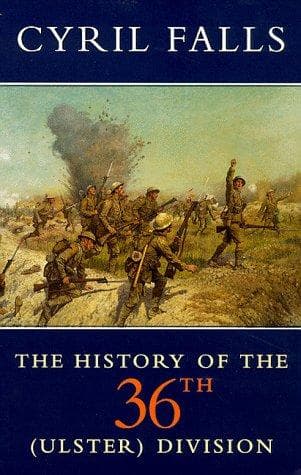
The History of the 36th (Ulster) DivisionFalls, Cyril
History
The History of the 36th (Ulster) Division
Falls, Cyril
Great Britain. Army. Division, 36th; World War, 1914-1918 -- Regimental histories -- Great Britain
Two days later an attack on the left by the 1st and 9th Irish
Fusiliers, under a barrage of smoke and shrapnel, advanced the line
to the Haagedoorne-Dranoutre Road on a front of upwards of a mile. So
great was the surprise and so swift the assault, that the enemy was
"smothered," and did not make a serious resistance. Sixty prisoners
and eleven machine-guns were taken here. An enemy counter-attack in
the evening was brought to a stop by rifle and machine-gun fire,
though the 108th Brigade lost one small post. The line was now a
thousand yards only from Bailleul, and the defences of the town
were pierced. An attack upon the salient would now have resulted in
a great German rout. The enemy did not await it. Under the skilful
leadership, that was never more apparent than in the months of defeat
and humiliation which were to follow, he flitted in a night.
The 36th Division, on the morning of August the 30th, was awaiting
relief by the 35th Division, to be given a short period of rest
and training before being launched upon the great series of final
offensives in Flanders. Its right-hand neighbour, the 9th Division,
had already been relieved by the 31st Division on the Hoegenacker
Ridge, with a like object. That rest the 36th Division was not
destined to enjoy. At ten o'clock that morning came a report from the
31st Division that the enemy was gone from its front, and that its
men were entering Bailleul from the south. Before two o'clock patrols
of the 36th were in the huge Asylum north of the town, and upon the
Neuve Eglise Road. The relief was cancelled and an immediate advance
ordered, to be carried out by the 109th Brigade.
This was not the first enemy retirement in the Western theatre. There
had been that of 1917, in which some of the troops now in the 36th
Division had been the pursuers. No doubt the men who had then tracked
the retreating Germans had felt elation. But that had been false
dawn. Now, as men sprang up eagerly to set about their preparations,
a conviction spread among them that this was the true, that not again
would they have to turn back. Some of our present-day pessimists
pretend that by the summer of 1918 the horror, the iron ruthlessness,
of the war had robbed men of their stores of latent enthusiasm, and
that, even for victory, they had none to summon forth.
It is untrue. Were it true, they could not have so swiftly prevailed
against an enemy, disheartened indeed, but still disciplined,
tenacious and well led, still admirably equipped, and, above all,
backed by a series of defences such as the Allies, in their days
of adversity, had never dreamed of. All testimony, moreover, is to
the contrary. Like a flame the spirit of victory, the bright-hued
prospect of deliverance, spread among all ranks. Defeat and
retirement had bred melancholy and bad temper. The new atmosphere
dissipated them. To go forward, to strike, to make an end--those were
the impulses and the hopes that swept through the waiting ranks.
Public-domain text, read in full here on John Shaqi.
Reviews
Reviews
No reviews yet
Be the first to share your thoughts on this work.
Elsewhere in the archive
Join the Discussion
Join the discussion
Sign in to leave a comment or review.
Sign InorCreate an account