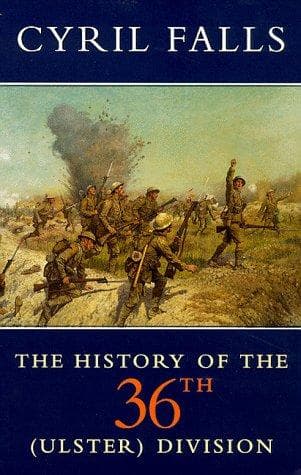
The History of the 36th (Ulster) DivisionFalls, Cyril
History
The History of the 36th (Ulster) Division
Falls, Cyril
Great Britain. Army. Division, 36th; World War, 1914-1918 -- Regimental histories -- Great Britain
Owing to lack of accommodation it was a few weeks before the Division
moved to an area where its musketry could be carried out. By the
2nd of September it was assembled at Bordon and Bramshott. Here the
final equipment arrived, and there was feverish activity in fitting
it. Here also the musketry course was fired, for the most part with
American ammunition, which gave unsatisfactory results.[15] And
here the rest of the Division came to closer quarters with its own
Artillery, which had arrived at Bordon from Lewes on August the
31st. To be frank, there was some dismay when it was discovered how
elementary was its training. A year was the estimate by some regular
officers of the time needed to make it fit for service. The critics
had yet to learn what could be accomplished by intensive training,
directed from above with skill and energy, backed by hard work,
loyalty, and the swift intelligence of the Cockney from below.
The senior officers were now sent to France for instructional
purposes, being attached to the 5th and 18th Divisions. On their
return, news met General Powell that during his absence Major-General
O. S. W. Nugent, D.S.O.,[16] who had commanded a Brigade in France
with distinction, had been appointed to succeed him. The grounds of
the decision were unexceptionable: that Divisions should be taken
to France by general officers with experience of the conditions of
warfare in that country. There was, however, throughout the Division,
much sympathy with General Powell, who had been allowed to make his
tour in the line in ignorance of the fact, which the staff officers
with whom he came in contact knew, that his successor had been
appointed. He received the honour of the K.C.B. in recognition of his
high services in the training of the Division. Sir Herbert Powell
finally went to Vladivostok in charge of the British Red Cross. The
new commander was to remain with the Division for over two and a
half years. To-day his name is universally associated with it.
On September the 30th, the 36th (Ulster) Division, with the 1st/1st
London Territorial Artillery, was reviewed by His Majesty King George
the Fifth. It was desired not to prolong unduly the march past, as
His Majesty always insisted on waiting till the last man had gone
by, and General Nugent decided that the Artillery should advance in
column of batteries, and the Infantry in column of half-companies
with reduced intervals. It was a high test, triumphantly
accomplished. Lord Kitchener informed General Sir A. Hunter, G.O.C.
Aldershot Command, that the inspection was the quickest the King had
made since the beginning of the war: a triumph of staff work and of
drill. None of those who saw them is likely to forget the physique or
the bearing of that splendid body of men. It is hard to think without
emotion of what the Division was that day and the fate that awaited
it.
Public-domain text, read in full here on John Shaqi.
Reviews
Reviews
No reviews yet
Be the first to share your thoughts on this work.
Join the Discussion
Join the discussion
Sign in to leave a comment or review.
Sign InorCreate an account