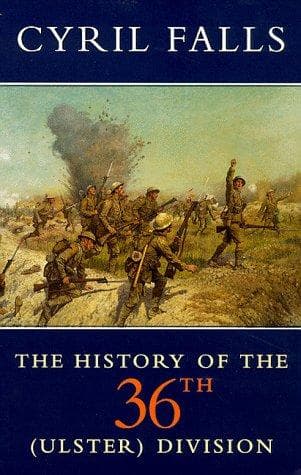
The History of the 36th (Ulster) DivisionFalls, Cyril
History
The History of the 36th (Ulster) Division
Falls, Cyril
Great Britain. Army. Division, 36th; World War, 1914-1918 -- Regimental histories -- Great Britain
The severest resistance was met at Westhof Farm and De Broeken, both
well known of old, where German machine-guns caused serious loss.
German artillery fire was also heavy. The various strong points were
taken one by one. The German rearguards slipped back in each case
before our men came upon them, but a number were killed in flight
and, outside Neuve Eglise, a machine-gun and two prisoners captured.
By afternoon the enemy had been driven back to the western outskirts
of the village. Some of the 2nd Inniskillings appear actually to have
reached its houses, but the line finally taken up at night was five
hundred yards short of it.
The 108th Brigade was ordered to pass through the 109th at night and
resume the advance, its objectives being from Red Lodge, in the
north-west corner of "Plug Street Wood," to South Midland Farm on the
Wulverghem-Messines Road. The artillery was now in a position to give
it adequate support. The attack was carried out by the 12th Rifles on
the right and 1st Irish Fusiliers on the left. On its southern flank,
Kortepyp Cabaret and the Custom House on the Steenwerck Road gave
trouble.[59] A Stokes mortar here well repaid the labour of bringing
it and its ammunition forward, enabling the infantry to rush these
places after a short bombardment. Then the line pressed forward to
the Nieppe Road running south-east from Neuve Eglise. Machine-gun
fire from this village was at first galling, but, after it had been
heavily shelled by the artillery, a company of the 12th Rifles took
it in most gallant fashion, while two other companies made progress
to the south of it. By four o'clock the line was east of Neuve Eglise.
The next obstacle was a fairly formidable one, an old British
system, the name of which recalled the days when the British Army
had been a very small force indeed--the G.H.Q. Line. The Germans
had put up some wire to defend its support trench from the west. At
7-30 p.m., light being still good, our artillery bombarded these
defences heavily for an hour, after which the infantry advanced to
the attack. The trenches were not taken without fighting, though,
in all the circumstances, the enemy's resistance must be reckoned
feeble. Desultory encounters continued all night, but by morning the
infantry was in possession of the G.H.Q. Line along the whole front.
On the left, meanwhile, the troops of the 30th Division had entered
Wulverghem.
Public-domain text, read in full here on John Shaqi.
Reviews
Reviews
No reviews yet
Be the first to share your thoughts on this work.
Elsewhere in the archive
Join the Discussion
Join the discussion
Sign in to leave a comment or review.
Sign InorCreate an account