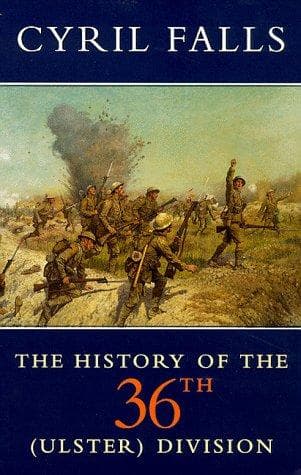
The History of the 36th (Ulster) DivisionFalls, Cyril
History
The History of the 36th (Ulster) Division
Falls, Cyril
Great Britain. Army. Division, 36th; World War, 1914-1918 -- Regimental histories -- Great Britain
On the 3rd, as resistance stiffened, the frontage was narrowed. A
Brigade of the 29th Division had just relieved the 31st Division
troops on the right for the assault on the very important position
of Hill 63. The new objective of the 108th Brigade was from White
Gates, at the western foot of this hill, to South Midland Farm. At
9-30 a.m. the 12th Rifles and 1st Irish Fusiliers went forward. In
the early stages they had artillery support. Thereafter, owing to
constant movement and the difficulty of ascertaining the position of
the front line, the only assistance that could be rendered by the
artillery was by fire on objectives far in rear, save for occasional
opportunities that came the way of single mobile guns. The attack
resolved itself into individual assaults upon German machine-gun
positions, which were taken in flank by Lewis guns worked forward,
and then rushed with the bayonet. Three were thus taken, and their
detachments killed or captured, while none of the latter, which ran
before the infantry came upon them, escaped without loss from our
fire. By evening the line ran from L'Alouette, a mile east of Neuve
Eglise, to La Plus Douve Farm, a famous old battalion headquarters of
the 36th Division, south-east of Wulverghem. The whole of this front
was taken over after dark by the 9th Irish Fusiliers, which battalion
had not yet been in action.
The 108th Brigade's attack next morning began at 8-30 a.m. under a
creeping barrage. Half an hour prior to it, on the extreme right,
the 9th Irish Fusiliers advanced about a hundred yards toward Hill
63, to support an attack on the hill by troops of the 29th Division.
The attack was completely successful. Hill 63 was of the greatest
importance to the enemy, and was very strongly held, as was proved by
the capture of nearly two hundred and fifty prisoners by the men of
the 29th Division. The hill being in British hands made affairs far
easier for the 108th Brigade. The advance of the 9th Irish Fusiliers
met with considerable opposition. Gaps appeared, and there was some
loss of direction, not astonishing when it is considered that the
battalion was on a frontage of over a mile. Eventually a company of
the 1st Irish Fusiliers had to be brought up on the right flank,
on the Neuve Eglise-La Basseville Road. Before noon all objectives
were attained. On the right the 1st Irish Fusiliers had advanced
beyond White Gates. On the left, Gooseberry Farm, a mile east of the
starting-line, was in the hands of the 9th.
All had gone excellently so far. But the British were now facing
positions which the Germans desired to hold for some time longer, for
which they were prepared to fight. An immediate local counter-attack
down the Douve valley was repulsed with the aid of artillery fire.
But at 4-15 p.m., after a heavy bombardment, the enemy launched
a counter-attack from the south-west on this part of the line.
Gooseberry Farm and Stinking Farm[60] were lost, and the line driven
back five hundred yards.
Public-domain text, read in full here on John Shaqi.
Reviews
Reviews
No reviews yet
Be the first to share your thoughts on this work.
Elsewhere in the archive
Join the Discussion
Join the discussion
Sign in to leave a comment or review.
Sign InorCreate an account