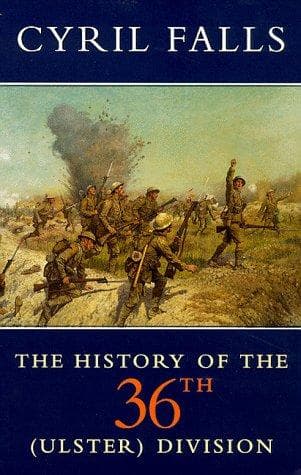
The History of the 36th (Ulster) DivisionFalls, Cyril
History
The History of the 36th (Ulster) Division
Falls, Cyril
Great Britain. Army. Division, 36th; World War, 1914-1918 -- Regimental histories -- Great Britain
After a few days of rest and training, the concentration took place
on the nights of the 26th and 27th. By the morning of the 28th,
the date of the attack, the three Brigades were in camps between
Poperinghe and Vlamertinghe. Headquarters were at Vogeltje Château,
near the better-known Lovie Château, in the woodlands west of
Poperinghe. The Division was again in General Jacob's II. Corps,
under which it had served in April, May, and June. It was in Corps
Reserve, its mission being to hold itself in readiness for a move
forward to assist in the exploitation of any success gained by the
first-line Divisions.
The late operations had been heartening. Despite, however, their
difficulty and costliness, they represented, at least till the final
stages, no more than hard and steady pressure upon a rearguard. No
great number of prisoners could be taken in such fighting, while the
casualties to be inflicted upon the enemy were comparatively small.
The Division had not yet had a hand in one of the great offensives.
All ranks knew that the attack about to open ranked in that category,
and that resistance of far more serious quality was to be expected.
For that they were prepared. It is no exaggeration to say that they
looked forward to the coming struggle, just because they believed it
would be the last. Officers who came back from England the day after
the opening of the attack, when the news that from Ypres to the sea
the whole line was advancing had been flashed abroad, describe the
returning leave-boat as being so full of cheerful faces that it might
have been taken for one homeward bound. Some were less ambitious than
others. In one officer's diary is expressed the opinion that the
Passchendaele Ridge, if captured, would serve as a good "jumping-off"
ground for an offensive the following spring! But for the most part,
men, beholding victory upon victory, had come to believe that the war
could be ended this year. For that speed was essential, else winter
would come to the aid of the enemy and give him time to collect
himself. That reasoning could be grasped by all, and acted upon all
as an added spur to endeavour in the days that followed.
FOOTNOTES:
[58] General Coffin was at this time on leave, the Division being
commanded by Brigadier-General Brock, the C.R.A.
[59] _i.e._, the Belgian Custom House, Neuve Eglise being in Belgium,
Steenwerck and Bailleul in France.
[60] The farm had earned its horrible name in 1915 from the odour
of a huge store of rotten potatoes in its cellars. These had been
removed the following year by sappers of the 36th Division, wearing
gas-masks. Thereafter it stank no worse than any other ruin in the
Flanders front line.
CHAPTER XIV
THE ADVANCE TO FINAL VICTORY (I): SEPTEMBER 28TH TO OCTOBER 17TH, 1918
Public-domain text, read in full here on John Shaqi.
Reviews
Reviews
No reviews yet
Be the first to share your thoughts on this work.
Elsewhere in the archive
Join the Discussion
Join the discussion
Sign in to leave a comment or review.
Sign InorCreate an account