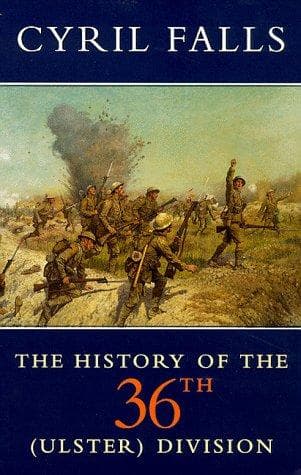
The History of the 36th (Ulster) DivisionFalls, Cyril
History
The History of the 36th (Ulster) Division
Falls, Cyril
Great Britain. Army. Division, 36th; World War, 1914-1918 -- Regimental histories -- Great Britain
single bomb killed five men, wounded nine, and killed no less than
fifty valuable horses, besides injuring about twenty more. A bomb or
big shell in crowded horse-lines was always one of the ugliest sights
of many very ugly that the war had to display.
On the night of September the 15th the 109th Brigade took over
the front, now slightly extended on the right toward Ploegsteert.
There was constant patrol activity in the days that followed, but
no further ground was to be gained by those methods. The enemy
was maintaining himself very stoutly and his line bristled with
machine-guns. It was evident that only a great "full-dress" assault
would retake the Messines Ridge.
The tide of victory meanwhile had continued to flow strongly on
other fronts. On the 12th of September the Third Army had crashed
through the Hindenburg trenches at Havrincourt. Three days later
the Balkan offensive, so long awaited that men had come to doubt
its possibility, had been launched, and attended with overwhelming
success. Within a few days Bulgaria was prostrate and Turkey out
of the war. It would have been poetical justice had it fallen to
the lot of the 36th Division to have a hand in the second capture
of the Messines Ridge, as the 62nd Division had taken Havrincourt
for the second time. If that were denied it, it was only because it
had a task even more important to perform, a task the successful
prosecution of which would render to the enemy the famous ridge of
no avail. As a necessary complement to the great convergent thrusts
of British, French, and American armies further south, a powerful
offensive, mainly Anglo-Belgian, but in which a French force also
took part, had been planned in Flanders, from Voormezeele northwards.
It was to be under the supreme command of His Majesty the King of
the Belgians, so that co-ordination between the three nationalities
should be assured. For this the 36th Division was required. For the
third time in its career, but in circumstances vastly different to
the two first, it was directed upon Ypres. For the new battle some
training had been obtained by the 107th and 108th Brigades during
the days that the 109th held the line.
The movements were carried out with greatest secrecy. All marches
took place after dark, on the nights of September the 21st and 22nd.
The 107th moved thus to Wormhoudt, north of Cassel, the 109th Brigade
to Eecke, east of that town, and the 108th to Houtquerque. The
Divisional Artillery moved straight to the neighbourhood of Ypres.
The Infantry of the Division was not to take part in the first day's
attack, and, for the preliminary barrage, the 153rd Brigade R.F.A.
was to be attached to the 9th Division, the 173rd Brigade to the 29th
Division, on its right, the troops of which were in line slightly
over a mile east of the famous ruined town.
Public-domain text, read in full here on John Shaqi.
Reviews
Reviews
No reviews yet
Be the first to share your thoughts on this work.
Elsewhere in the archive
Join the Discussion
Join the discussion
Sign in to leave a comment or review.
Sign InorCreate an account