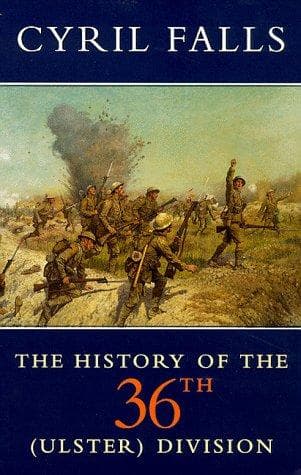
The History of the 36th (Ulster) DivisionFalls, Cyril
History
The History of the 36th (Ulster) Division
Falls, Cyril
Great Britain. Army. Division, 36th; World War, 1914-1918 -- Regimental histories -- Great Britain
By an early hour it had been apparent that affairs were marching
swiftly, and at eleven in the morning the II. Corps ordered the 36th
Division to move forward, with its Infantry Brigades in echelon.
The 109th was ordered to entrain first, and was carried by light
railway to Potijze, where it detrained at 3 p.m. It then received
orders to march to the neighbourhood of the Bellewaarde Lake. The
108th Brigade was moved east of Ypres at noon; the 107th to Potijze
later in the afternoon. So fast had been the advance that the 107th
Brigade's first orders were to move no further than Vlamertinghe,
but on arrival the men were told to keep their places in the trucks,
which bore them forward another three miles before dusk. Headquarters
of the Division were established in the old dug-outs of the Ypres
Ramparts at 2 p.m.
The plan for the 29th of September was that one Brigade of the
36th--the 109th--was to come into line between the 29th and 9th
Divisions. The 109th Brigade was to be supported by the 153rd Brigade
R.F.A., hitherto under the orders of the 9th Division, if its
batteries could be got into action in time. As a matter of fact,
owing to the shocking state of the roads, they were not able to fire
a shot till the next day. The 109th Brigade was to pass through the
27th Brigade in Becelaere, the latter Brigade then following in
rear of the assaulting Brigade of its own Division. The objective
of the 109th was Terhand, but, if this were easily attained, the
intention was to exploit the success. It was attacking with the 2nd
Inniskillings on the right, the 9th on the left, and the 1st in
support. A dawn assault would have been desirable, but, owing to the
difficulty the 109th Brigade experienced in advancing by night across
broken country on roads so damaged and thronged, it was postponed
till 9-30 a.m. The Brigade's difficulties were increased by heavy
bombing of the approaches to the line by enemy aircraft during the
hours of darkness.
The rain continued all night, accompanied by great cold, and in
this blasted area there was no shelter for the troops. By a stroke
of fortune, however, the weather improved in the morning, the sun
appearing just about the hour of Zero. The advance was at first very
rapid. If the 109th had no artillery support, it had small opposition
from that arm. Its difficulties were caused by machine-guns, singly
or in nests of from two to five, cleverly disposed in depth behind
hedges or in buildings. For hedges there were now, and, though the
ground had been heavily shelled, it was no longer the sea of mud and
shell-holes of the old Salient battle-ground.
Public-domain text, read in full here on John Shaqi.
Reviews
Reviews
No reviews yet
Be the first to share your thoughts on this work.
Elsewhere in the archive
Join the Discussion
Join the discussion
Sign in to leave a comment or review.
Sign InorCreate an account