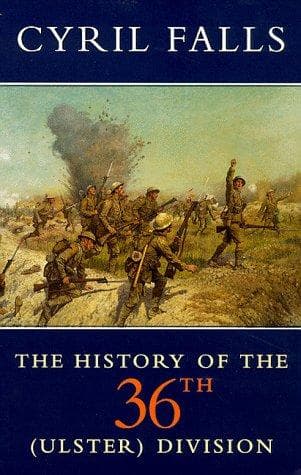
The History of the 36th (Ulster) DivisionFalls, Cyril
History
The History of the 36th (Ulster) Division
Falls, Cyril
Great Britain. Army. Division, 36th; World War, 1914-1918 -- Regimental histories -- Great Britain
These German machine-guns were attacked with greatest _élan_. Often
the leading infantry put them out of action by rifle-fire before
the Lewis guns, a serious burden on such ground, could be brought
into action against them. Still, there is no reason to doubt that
the rate of advance could have been swifter had artillery support
been available. The left battalion, the 9th Inniskillings, aided
by the magnificent rush of the 9th Division to north of it, found
matters considerably easier than did the 2nd Inniskillings on the
right. From two o'clock onwards the latter was held up by machine-gun
fire from Terhand, while the former pressed forward north of the
village. Terhand fell at last at a quarter to four. By this time
the 9th Inniskillings was on the southern outskirts of Dadizeele,
which was captured by the 9th Division a few minutes later. Then, at
six o'clock, the 9th Inniskillings forced its way into Vijfwegen, a
road-side hamlet a mile south of Dadizeele.
The day's advance had been once more remarkable, but much more so on
the left of the II. Corps than on its right flank. The 9th Division,
from Becelaere to Dadizeele, had gained well-nigh three miles of
ground. From Vijfwegen, however, the line ran almost west--that is to
say, it faced south--to Terhand, and thence to south of Becelaere,
where the 29th Division had been held up.
At 4 a.m. the 108th Brigade had moved off in support to the 109th,
being upon the high ground west of Becelaere by 7 p.m. It was ordered
to move forward again, pass through the 109th at dawn, and advance
with as objective the great Menin-Roulers highway from Kezelberg
northward. The 29th Division, meanwhile, was to make a great effort
to force its way up into line on the right. "D" Company of the
Machine-Gun Battalion was attached to the 108th Brigade, together
with its own Stokes Mortar Battery.
The position to be attacked had few artificial defences--the German
wired line defending Menin and Roulers was just west of Dadizeele and
Vijfwegen, and had already been pierced--but it was naturally strong.
The embankment of the huge main road formed good protection to the
enemy. But the key to the position was a hillock half-way between
the road and Vijfwegen--Hill 41. Sixty feet above the surrounding
country, crowned with several farms and their outbuildings, which had
been strengthened with concrete, it was at once invaluable to the
enemy and an excellent defensive position in fighting of this nature,
when very little artillery was available to shake its machine-gun
detachments prior to the infantry assault. With plenty, even of field
artillery, it would not have been a very formidable obstacle, while a
concentration of heavy artillery would have blown the defenders off
its crest. But the big guns were still far behind.
Public-domain text, read in full here on John Shaqi.
Reviews
Reviews
No reviews yet
Be the first to share your thoughts on this work.
Elsewhere in the archive
Join the Discussion
Join the discussion
Sign in to leave a comment or review.
Sign InorCreate an account