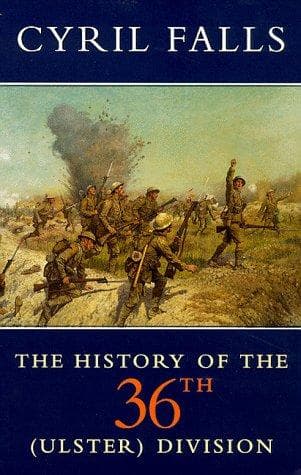
The History of the 36th (Ulster) DivisionFalls, Cyril
History
The History of the 36th (Ulster) Division
Falls, Cyril
Great Britain. Army. Division, 36th; World War, 1914-1918 -- Regimental histories -- Great Britain
The first general objective of the II. Corps was the
Courtrai-Ingelmunster Railway. Upon this the 36th Division was
directed, from the Lys on the right to the northern skirts of the
town of Heule. It had also upon its front two other small towns,
Moorseele and Gulleghem. The three were in a straight line from west
to east; Moorseele being about two and a half miles from the present
position, Gulleghem four and a half, and Heule six. The attack was
to be carried out by the 107th Brigade on the right, and the 109th
on the left. To the former was attached the 121st, and to the latter
the 150th Field Company, while each had a company of the Machine-Gun
Battalion. A section of each Field Company was in readiness to bridge
the Heulebeek if necessary. The Divisional Reserve consisted of the
108th Brigade, the 36th Machine-Gun Battalion (less two companies),
the 16th Rifles (Pioneers), the 122nd Field Company, two platoons
of VIII. Corps Cyclists, and a company of the 104th Machine-Gun
Battalion. Each Brigade was to attack with one battalion in line, one
in support, and one in reserve. The Division's frontage was about a
thousand yards, though on the objective of the Courtrai-Ingelmunster
Railway it grew to fifteen hundred.
With the artillery now at the disposal of the Division, and the
considerable heavy artillery at that of the II. Corps, the barrage
was to be something like the barrage of old days. There was, in fact,
one field gun or howitzer to a little more than twenty yards. There
was to be no preliminary bombardment. The barrage was to come down
two hundred yards in front of the forming-up line of the infantry
three minutes before Zero, and to begin to creep forward at that
hour. It was to move at a rate that would have seemed incredible a
year ago, one hundred yards in two minutes, with a pause of fifteen
minutes every fifteen hundred yards. East of Moorseele the field
artillery barrage was to halt from Zero plus 115 minutes to Zero plus
132 minutes, then to cease. Upon this line the infantry was to remain
an hour, to allow the support battalions to pass through the leaders,
and batteries of field artillery to move up west of the town and aid
the next advance.
At two o'clock on the morning of October the 14th the attacking
troops were formed up east of the Vijfwegen-Zuidhoek Road, in
trenches hastily dug by the Pioneers and 122nd Field Company. At the
same hour the 108th Brigade began a quiet withdrawal, leaving its
outposts on Hill 41 in position. The batteries of the field artillery
were in position close up to the front line. Even then their final
barrage east of Moorseele would be at almost extreme range for the
18-pounders.
Public-domain text, read in full here on John Shaqi.
Reviews
Reviews
No reviews yet
Be the first to share your thoughts on this work.
Elsewhere in the archive
Join the Discussion
Join the discussion
Sign in to leave a comment or review.
Sign InorCreate an account