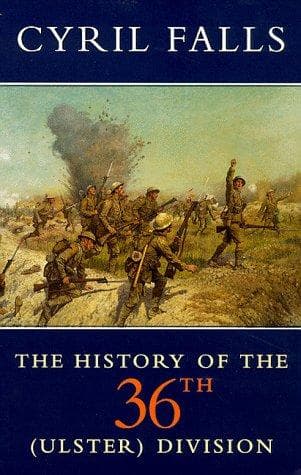
The History of the 36th (Ulster) DivisionFalls, Cyril
History
The History of the 36th (Ulster) Division
Falls, Cyril
Great Britain. Army. Division, 36th; World War, 1914-1918 -- Regimental histories -- Great Britain
The next three days passed without further attempt at progress on the
front of the 36th Division. All along the line, indeed, the advance
was held up, and preparations were in train for an important new
attack. For this it was necessary that the troops should have some
preliminary rest. On the night of the 4th the 108th Brigade again
relieved the 109th, while the 107th was relieved by troops of the
35th Division. On the 7th the 109th Brigade moved back across the
devastation to a camp between Ypres and Poperinghe, where baths and
clean clothes could be provided, and training for the new battle
carried out. The 107th Brigade had not such good fortune, as it was
retired as far only as Polygon Wood, and accommodated in canvas
trench shelters.
Meanwhile artillery had moved up in force. By October the 7th there
was in position covering the 36th Division's frontage its own
Divisional Artillery, the 113th Army Brigade, and three batteries of
the 4th French Cavalry Division. Medium trench mortars, including the
6-inch Stokes, had also been brought forward in face of extraordinary
difficulties. The enemy's artillery was very active, and the shelling
in its intensity now recalled the days of the big battles of trench
warfare.
On October the 11th, after an intense artillery preparation, in which
the trench mortars took part, two platoons of the 9th Irish Fusiliers
captured Goldflake Farm, with fourteen prisoners and three light
machine-guns. This very strong "pill-box," on the southern slope
of Hill 41, had defied all previous attempts. It did not on this
occasion remain long in our hands. At evening, after a tremendous
bombardment, the enemy launched an attack on the hill. Not only was
Goldflake Farm retaken, but from Twigg and Mansard Farms, on the
crest, our men were driven out. An immediate counter-attack caused
Twigg Farm to change hands for the third time. Next morning before
it was light a patrol got back Mansard Farm, with another prisoner
and another machine-gun. That was the last of the local fighting. All
things were now prepared for attack upon a very different scale.
The 35th Division, it has been recorded, had come into line on the
right of the 36th. At the same time the 29th, its old right-hand
neighbour, had been moved up to its left flank, from Klephoek
northward, and now separated it from the 9th Division. The Second
Army and the Belgians were now to attack with the objective of the
Lys. This operation, if successful, would almost certainly cause the
enemy to evacuate the great industrial cities of Lille, Roubaix, and
Tourcoing.
Public-domain text, read in full here on John Shaqi.
Reviews
Reviews
No reviews yet
Be the first to share your thoughts on this work.
Elsewhere in the archive
Join the Discussion
Join the discussion
Sign in to leave a comment or review.
Sign InorCreate an account