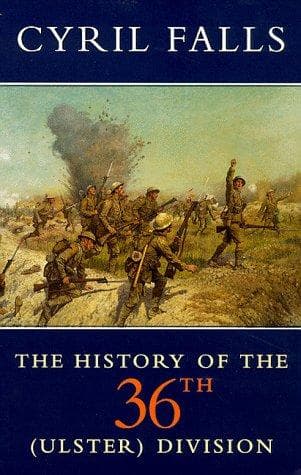
The History of the 36th (Ulster) DivisionFalls, Cyril
History
The History of the 36th (Ulster) Division
Falls, Cyril
Great Britain. Army. Division, 36th; World War, 1914-1918 -- Regimental histories -- Great Britain
At 2 p.m. a smoke-screen was put down. Five minutes later, under
its cover, the first boat-load was across. The men leapt ashore
exultingly and drove the Germans from the bank. They had had scarce
a casualty. Another boat-load followed, and in an incredibly
short time the bridge was practicable for infantry. But the German
artillery soon had its range. The men of the 122nd Field Company, who
displayed the greatest gallantry, suffered heavy loss, and eventually
the bridge was destroyed. The party on the other shore, however, held
its ground without difficulty. The machine-gunners of "C" Company,
attached to the Brigade, distinguished themselves particularly in
this day's operations.
The obvious course now was to await darkness, throw another bridge
across, clear the city of Germans, and be ready to advance eastward
at peep of day. But news arrived meanwhile which altered these plans.
The Allies were not going to batter Courtrai. They were going to
force the Lys to northward, swing half-right, and drive down upon
the Scheldt, or Escaut, as this portion of the river is called by
French-speaking people, thus turning all the great industrial towns.
As a fact, the evacuation of Lille, the western-most, was proceeding
at this very moment. The 36th Division was required for the new
thrust, and was to be relieved at once by the 123rd Brigade of the
41st Division.
In these circumstances, as the bridgehead--without a bridge--was
useless to the relieving Brigade, the bridgehead party was quietly
and skilfully withdrawn at dusk and ferried across, together with
six captured Germans. The relief was complete by eight o'clock, and
the 108th Brigade marched back through new-won Heule and Gulleghem,
to the village of Drei Masten, north of the latter town. The other
Brigades had begun to move back earlier in the afternoon.
If the troops had been cheerful before, they were jubilant now. They
knew themselves infinitely better men than the enemy, who, still
supported by huge masses of artillery and by machine-gun fire which
General Jacob later described as "the heaviest ever experienced in
this war," never awaited their onslaught long. It was evident to all
now that the war would be over by Christmas. A little longer and the
German Army would be beaten to its knees.
Public-domain text, read in full here on John Shaqi.
Reviews
Reviews
No reviews yet
Be the first to share your thoughts on this work.
Elsewhere in the archive
Join the Discussion
Join the discussion
Sign in to leave a comment or review.
Sign InorCreate an account