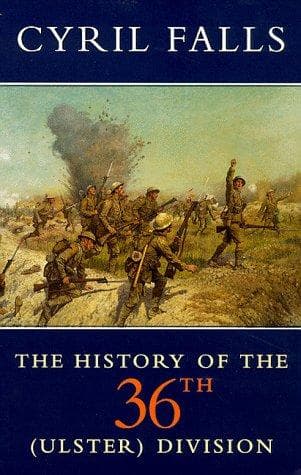
The History of the 36th (Ulster) DivisionFalls, Cyril
History
The History of the 36th (Ulster) Division
Falls, Cyril
Great Britain. Army. Division, 36th; World War, 1914-1918 -- Regimental histories -- Great Britain
The advance of the 21st was timed for 7-30 a.m. It was to be carried
out by the 1st Rifles of the 107th Brigade, and the 1st Irish
Fusiliers of the 108th. It was, however, important to be rid of the
hornet's nest in Dries upon the flank, and this village was cleared
by a company of the 12th Rifles before the attack began. Without
artillery this attack was of the greatest difficulty. There were no
hedges, and it was the custom in this part of the country to lop the
lower branches off the trees. Consequently, the attacking force was
constantly exposed to long-range machine-gun fire. Moreover, the
133rd French Regiment, since it had to fight its way from the river
bank, was always in rear. In all the circumstances the advance of the
day, which found the right of the 107th Brigade at Knock, north of
Vichte, and the left of the 108th at Spitael, on the Ghent Railway,
was highly creditable to the troops concerned. The advance of the
107th Brigade, with the 9th Division on its right, was to be resumed
on the morrow, but it was decided that the 108th Brigade should not
move till the French had come up into line.
By the morning of the 22nd the Lys was crossed by bridge after bridge
in the area of the 36th Division; there being, besides numerous
foot-bridges, three medium bridges for first-line transport, and a
trestle which was subsequently used by French motor-lorries. On the
night of the 21st the four batteries of the 153rd Brigade R.F.A.
crossed the river, to fire a barrage in support of the 107th Brigade
next day. On the right, upwards of half the distance between the
parallel rivers, the Lys and the Escaut, had now been covered. From
the Gaverbeek onwards the advance was now faced by rising ground,
which culminated in a general ridge before the drop down, over some
two miles, to the valley of the latter river. The various little
crests of this chain afforded excellent positions to the enemy, and
it was evident that, if so disposed, he could make a very effective
stand before falling back across the Escaut. The first of them had
to be attacked on this morning. It was taken by the 2nd Rifles. The
barrage, small though it would have been reckoned in old days,
and as it was in comparison with the German barrage which had to
be faced, nevertheless made a wonderful difference to the attack.
The little rise, about a mile north-east of Vichte and topped by
a windmill, was carried. But there followed the most resolute
counter-attack experienced for a long time by the 36th Division. It
was made by a Prussian Assault Battalion, and succeeded in driving
our men off the crest and back for almost eight hundred yards.
Colonel Becher, commanding the 2nd Rifles, organized a new attack
by two companies, which, going forward with the greatest gallantry,
once more drove the Germans off the crest and re-established the
position. The left flank swung sharply back, the junction with the
108th Brigade being on the Deerlyck-Waereghem Road. On the left of
Public-domain text, read in full here on John Shaqi.
Reviews
Reviews
No reviews yet
Be the first to share your thoughts on this work.
Elsewhere in the archive
Join the Discussion
Join the discussion
Sign in to leave a comment or review.
Sign InorCreate an account