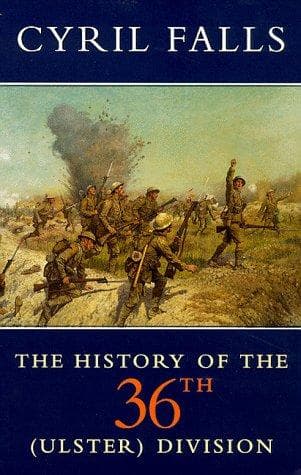
The History of the 36th (Ulster) DivisionFalls, Cyril
History
The History of the 36th (Ulster) Division
Falls, Cyril
Great Britain. Army. Division, 36th; World War, 1914-1918 -- Regimental histories -- Great Britain
The 9th Division had captured the twin crests of Ingoyghem and
Ooteghem, and it was determined that the 109th Brigade should, the
same afternoon, assault that of Kleineberg, to their north-east,
which would have brought the right of the Division, its left drawn
back through circumstances beyond its control, into the van of the
advance. A new barrage, starting at 5 p.m., was hastily planned
and admirably carried out. Unfortunately, however, orders did not
reach the battalions soon enough, and, at the appointed hour, three
companies only, two of the 1st Inniskillings and one of the 2nd, went
forward to the attack. And it must be remembered that companies were
now never more than fifty strong. The crest was actually reached, but
the advance had been on a frontage so narrow that it was impossible
to maintain the position. A farm-house at the foot of the slope was,
however, held and consolidated.
The 26th was a day of calm, broken when night fell by tremendous
shelling, above all with gas, which seemed almost to have superseded
high explosive and shrapnel in the enemy's armoury. Nor was a further
advance contemplated on the 27th, owing to the complete exhaustion
of the troops. A wounded prisoner had, however, reported that it was
the enemy's intention to withdraw at once to the Escaut, and our
outposts were on the _qui vive_ for signs of such a movement. About
2 p.m. that afternoon they were rewarded. Small bodies of the enemy
were seen retiring from the Kleineberg Ridge. Instantly patrols of
the 109th Brigade were pushed forward and occupied it. And so this
last goal of the 36th Division, after three years' campaigning,
was reached without a shot fired. The 108th Brigade, in attempting
to follow suit, met with a certain resistance, but the 9th Irish
Fusiliers had the railway "halt" west of Anseghem before dusk.
Attempts were made to push onward to the river, but it was found that
the Germans still held Bergstraat with machine-guns, and no further
progress could be made. It was quite evident that they were not
going to fall back on the Escaut till forced to do so. Their policy,
directed with great skill--for never did the work of their divisional
and regimental commanders shine more brightly than in these days--was
to give up what could not be held, and no more, thus husbanding till
the last the declining moral of their infantrymen, and delaying the
advance as long as might be. A resistance more rigid, with the German
soldier in his present temper, would inevitably have led to a break
through, somewhere or other, and a consequent rout.
Public-domain text, read in full here on John Shaqi.
Reviews
Reviews
No reviews yet
Be the first to share your thoughts on this work.
Elsewhere in the archive
Join the Discussion
Join the discussion
Sign in to leave a comment or review.
Sign InorCreate an account