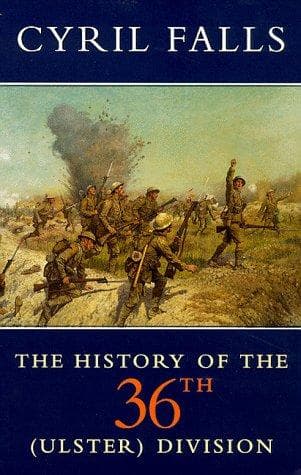
The History of the 36th (Ulster) DivisionFalls, Cyril
History
The History of the 36th (Ulster) Division
Falls, Cyril
Great Britain. Army. Division, 36th; World War, 1914-1918 -- Regimental histories -- Great Britain
Soon after the Armistice the 36th Division settled down for the
winter astride the Franco-Belgian frontier. Headquarters, the 107th
and 108th Infantry Brigades, the 121st and 122nd Field Companies
R.E., and the 16th Rifles (Pioneers) were one side, at Mouscron. The
Artillery, in Tourcoing, the 109th Brigade and 150th Field Company,
at Roncq, were the other. The Pioneers had the hardest work, being
employed on railway reconstruction and upon the Escaut bridges. Some
military training, mainly ceremonial, was carried out. But chief
energies were devoted to recreation and to the education scheme,
which attempted to provide for the young soldiers some preparation
for the civil life to which they would shortly be returning. The idea
was a worthy one, and was organized with skill and enthusiasm, yet
it is to be doubted whether a large proportion had much benefit of
it. By the time it was really in full swing, demobilization was at
the same stage. The majority of the men attended but a few classes
before they returned, and can have acquired but a smattering of the
subjects they were pursuing. December was the most successful month,
when there were recorded 54,203 attendances at the various classes.
On the lighter side there were competitions in Rugby and Association
football, cross-country running, boxing, and rifle-shooting.
Christmas, the fifth since the Division's formation, its fourth
since crossing the Channel, was happily celebrated. The Divisional
Canteen had on this occasion its greatest triumph. The position was
difficult. Behind lay the area of the Ypres battlefields; around, the
country had been practically denuded of food-stuffs by the Germans.
The Canteen Officer had, in the first place, made arrangements with
a farmer near Dunkirk to attend markets in that region, buy up
poultry, and feed them on her farm till it was time to kill them for
Christmas. Had a British officer done the buying, the prices would
have been prohibitive. It was soon found that the good _fermière's_
estate would not hold all the birds required, and a further order was
placed with the _Halles_ in Paris, through a Dunkirk merchant. Pigs
were also bought, to be killed on the appointed day. But difficulties
grew with demands. Lorries broke down in the swamps about Ypres. The
Canteen Officer began to wonder whether his head upon a charger would
not be the chief dish of the occasion. On Christmas Eve the Paris
consignment arrived at Dunkirk, but it was in the middle of a line of
trucks which could not be disentangled, and would not have been for
days. Finally, after some shunting, a lorry was got alongside. When
the lorry arrived at Mouscron it was found to contain also a large
case of eggs, a luxury unknown for months, a special order for some
unit in Dunkirk. Naturally it was then impossible to send it back.
Every man in the Division had plentiful fare, while, adds the Canteen
Officer modestly, "no other division in the district got anything
Public-domain text, read in full here on John Shaqi.
Reviews
Reviews
No reviews yet
Be the first to share your thoughts on this work.
Elsewhere in the archive
Join the Discussion
Join the discussion
Sign in to leave a comment or review.
Sign InorCreate an account