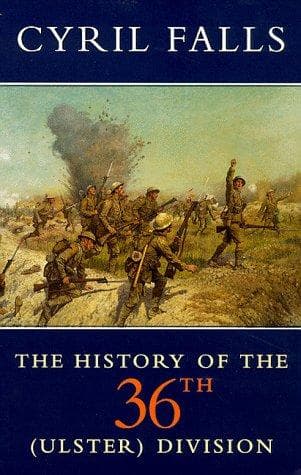
The History of the 36th (Ulster) DivisionFalls, Cyril
History
The History of the 36th (Ulster) Division
Falls, Cyril
Great Britain. Army. Division, 36th; World War, 1914-1918 -- Regimental histories -- Great Britain
better than bully beef." The present writer can bear witness that the
turkeys ordered for divisions on the Rhine arrived in many cases long
after Christmas, and frequently had to be buried forthwith by special
parties.
In the combatant ranks, alas! there were few who had spent the first
Christmas with the Division.
The following day there was the great ball given by the ladies of
Ghent to the British Army, which was attended by fifty officers of
the 36th Division. At the end of January, H.R.H. the Prince of Wales,
on his return from Germany, paid the Division a visit of two days.
This visit was informal and marked by no parades, but the Prince,
despite very bad weather, visited a number of units, and had long
conversations with officers and men on their experiences.
January was also the month when the flood of demobilization rose to
its height. In its course over four thousand officers and men were
sent home. In the following month came orders for one battalion to
be sent to Germany for service. The 12th Royal Irish Rifles was
chosen, and made up to strength from volunteers of the 1st, 2nd,
and 15th battalions of that regiment. On March the 2nd it entrained
at Mouscron, where the whole Division, less the Artillery, was
now concentrated, and proceeded to join the 2nd (now the Light)
Division on the Rhine. Soon afterwards the _cadres_ of the regular
battalions began to move home. On March the 12th the Field Marshal
Commanding-in-Chief paid a farewell visit to the Division. When he
laid down those duties that he had so splendidly and courageously
performed, it was indeed clear that the era of the Great War was
at an end. A few days later General Coffin, under whose vigorous
leadership the 36th Division had achieved its final triumphs, left
it to command a Brigade in the British Army of the Rhine. Divisional
Headquarters were reduced to _cadre_, the new commander being
Brigadier-General P. Leveson-Gower.
The last words were not written till June. Then the _cadres_ of the
remaining service battalions proceeded to the Base, and Headquarters
formally closed. In January the 36th Division had practically ceased
to exist. Now, six months later, its name departed from official
registers.
Public-domain text, read in full here on John Shaqi.
Reviews
Reviews
No reviews yet
Be the first to share your thoughts on this work.
Elsewhere in the archive
Join the Discussion
Join the discussion
Sign in to leave a comment or review.
Sign InorCreate an account