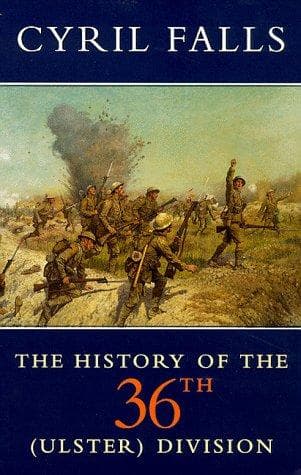
The History of the 36th (Ulster) DivisionFalls, Cyril
History
The History of the 36th (Ulster) Division
Falls, Cyril
Great Britain. Army. Division, 36th; World War, 1914-1918 -- Regimental histories -- Great Britain
In bright days and dark there can be no doubt but that much of its
success sprang from the mutual confidence and affection which existed
between all arms. If we can employ a word so inhuman as machine to
describe a corporation of men that was intensely alive, that had
a soul of its own, we may say that it was a machine that worked
smoothly because it was weak in none of its parts. And we must not
forget, as men are prone to forget, that, if some parts bore a weight
heavier than others, each was of equal importance in the working of
the machine. This record has been mainly concerned with the fighting
arms and, of these, to by far the greatest extent with the infantry.
For that no apology is made. It is as just as it is inevitable. It
is not only upon the infantry that all hinges; it is mainly by a
record of the infantry's movements that the story of battles is told.
Not alone the other fighting arms, Artillery, Engineers, Signals,
Pioneers, Machine-Gunners, but Medical and Supply Services also
were animated by the same high spirit of devotion. Of the two last
comparatively little has been said, and perhaps least of all of the
Supply Services. That is a compliment rather than the reverse.
Happy, says Montesquieu, is the people whose annals are humdrum.
The saying may be applied to Supply Services in war. The Royal Army
Service Corps of the 36th Division has few remarkable dates or
occurrences in its record, but that record is one long chain of which
the alternating links are steady work, forethought, and resource. The
other service of supply, the Ordnance, was always at a peculiarly
high standard, the Division being most fortunate in possessing a very
efficient D.A.D.O.S. in Captain Mackenzie, over a long period. Staff
Officers might come and might go, but "Dados" went on for ever.
There may be required some explanation of why, in this narrative, the
series of victories in 1918 is compressed in detail by comparison
with such actions as Messines and Cambrai. One reason is that the
records of the latter are far more complete. Another is that final
victory was won not only by the men who went forward so gallantly to
achieve it, but by all their silent comrades whose graves lay behind
them, who had fought a far more bitter battle.
These took the blows of the enemy upon their breasts, but, ere they
fell, the blows delivered by their arms had enfeebled him, so that
those who came after could strike home. Like Mr. Valiant-for-truth,
they might have proclaimed with their last breath: "My sword I give
to him that shall succeed me in my pilgrimage, and my courage and
skill to him that can get it. My marks and scars I carry with me."
For them, as for him, we may humbly believe that, when they passed
over, all the trumpets sounded on the other side.
Public-domain text, read in full here on John Shaqi.
Reviews
Reviews
No reviews yet
Be the first to share your thoughts on this work.
Elsewhere in the archive
Join the Discussion
Join the discussion
Sign in to leave a comment or review.
Sign InorCreate an account