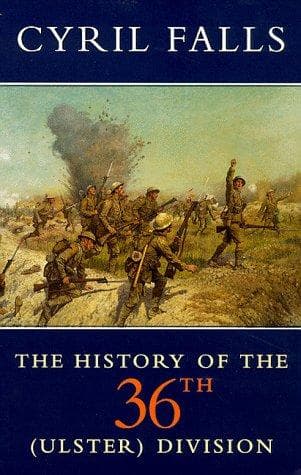
The History of the 36th (Ulster) DivisionFalls, Cyril
History
The History of the 36th (Ulster) Division
Falls, Cyril
Great Britain. Army. Division, 36th; World War, 1914-1918 -- Regimental histories -- Great Britain
Since the days of the first Battle of Ypres and of the rival turning
movements which had ended in the present deadlock, the Germans
had had the best of the ground in the Messines sector. Behind
the salient of their front trenches it rose sharply, with a dip
half-way up, formed by the shallow valley of the Steenebeek, to a
dominating ridge, crowned south and north by the fortress-villages
of Messines and Wytschaete. The road joining these was the limit of
our observation, except for telescopes on Kemmel Hill. To the south
we had a fair observation point in Hill 63, but the one great boon
granted to us was Kemmel. Had it been a thousand yards nearer the
front line, it would have done much to counteract the advantage of
the Messines-Wytschaete Ridge. It is scarcely necessary to add that
the enemy had, in his long possession of the ridge, fortified it with
all his wonted industry and art. It was protected by four general
lines of well wired trenches west of the road, and peppered over with
little forts, wired all round, the garrisons of which were provided
with concrete structures, miniature houses rather than dug-outs,
proof against anything up to an eight-inch shell.
General Plumer's Second Army was at this time playing the _rôle_ of
Cinderella among the British forces. Its front was lightly held,
even at Ypres, which had grown strangely quiet of late. Certain
preparations had been made for an offensive in the summer, but had
been largely abandoned for lack of labour. The Army Commander,
however, insisted on pushing on his mining, in which he had great
faith, a faith amply to be justified the following year. Throughout
the winter and spring the Division furnished large parties for work
under the various Tunnelling Companies in the shafts that were being
driven under "No Man's Land," and beneath the strongest portions
of the enemy's front line. The German miners were skilful enough,
and on other parts of the front often gave rather more than they
got, but here, from first to last, they were out-manœuvred and
out-fought in an underground war. A striking instance of this was at
La Petite Douve Farm, on the Ploegsteert-Messines Road, where the
British tunnellers succeeded in pumping a fair proportion of the
muddy Douve into the Germans' shaft, whence they could be heard,
night after night, frantically ejecting it with a motor-pump. One
"camouflet," as a defensive explosion was called, did indeed blow
in our gallery here and undo months of work, but the enemy probably
did not know what he had achieved, and the temporary check availed
him nothing in the end. No Ulsterman who served in Flanders in that
winter and the following spring will forget the skill, patience,
and absolute contempt for danger displayed by those tunnellers.
The 171st Tunnelling Company, with which the Division was most
closely associated, will be remembered with particular affection and
admiration.
Public-domain text, read in full here on John Shaqi.
Reviews
Reviews
No reviews yet
Be the first to share your thoughts on this work.
Elsewhere in the archive
Join the Discussion
Join the discussion
Sign in to leave a comment or review.
Sign InorCreate an account