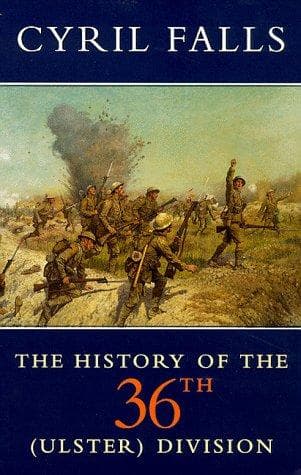
The History of the 36th (Ulster) DivisionFalls, Cyril
History
The History of the 36th (Ulster) Division
Falls, Cyril
Great Britain. Army. Division, 36th; World War, 1914-1918 -- Regimental histories -- Great Britain
The Second Army has been called the Cinderella of our forces. Not
only was it holding a long line lightly, and with few reserves, but
the main flow of ammunition and material passed it by and went down
to the Somme, where the British were creeping forward in desperate
fighting to Bapaume. There were weeks in August and September when
the allowance of shells dropped to two and even one round per
18-pounder a day, with heavier calibres proportionately rationed.[26]
The Germans were in this respect similarly situated. Their ammunition
also was wanted on the Somme to put down those eternal barrages with
which they opposed our assaults. When the Division first arrived in
Flanders the artillery shell-fire was very light indeed. That of
the trench mortars did a good deal to replace it. The Germans had
concentrated on these weapons as their chief means of offence, and,
possessing the advantage of the ground, they used them cleverly and
with great effect. With that curious regularity that appeared to form
part of the German mentality their bombardments generally took place
almost precisely at 3-30 p.m. They were particularly severe in the
neighbourhood of the Spanbroek salient.[27] "In this sector," writes
a machine-gun officer, "I have seen five or six large 'minnies' in
the air at one time--really fearsome things. You could see the
fuses of the bombs alight in the air and follow their flight most
of the way, only to lose it when straight overhead; and then there
was nothing to do but wonder where it would fall!" These long aerial
torpedoes exploded with shattering effect and made huge craters. It
is useless to disguise the fact that, during the first few weeks
of the Division's acquaintance with these trenches, the enemy had
an ascendancy in trench-mortar warfare. That ascendancy had to be
fought down. In the first place the German mortars, or rather their
emplacements, were carefully marked down from observations taken in
the line, and by the study of aeroplane photographs. Maps were then
issued by the staff, upon which each active emplacement was shown
by name. The names began with the letter of the map square; all in
the "S" squares with S, and in the "U" squares with U. The names
chosen were generally feminine--doubtless without ironic intention.
A certain number of the emplacements were allotted to each howitzer
battery of the Divisional Artillery, and also to such 6-inch howitzer
batteries of the Corps Heavy Artillery as were available. When the
mortar opened fire, all that was necessary was for the words "Susie
active," or "Ursula active," to be wired back to the batteries.
Susie, or Ursula, as the case might be, was instantly engaged, while
any machine-guns that could be brought to bear upon her neighbourhood
also took a hand in the game. By this means it was generally found
possible to silence any individual mortar in about a quarter of an
hour at most, and to prevent it from getting the exact range, and
Public-domain text, read in full here on John Shaqi.
Reviews
Reviews
No reviews yet
Be the first to share your thoughts on this work.
Elsewhere in the archive
Join the Discussion
Join the discussion
Sign in to leave a comment or review.
Sign InorCreate an account