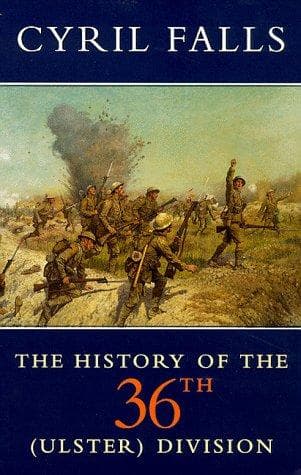
The History of the 36th (Ulster) DivisionFalls, Cyril
History
The History of the 36th (Ulster) Division
Falls, Cyril
Great Britain. Army. Division, 36th; World War, 1914-1918 -- Regimental histories -- Great Britain
then knocking in a whole section of trench at leisure.
On the British side, also, big trench-mortar bombardments, aided
by the Divisional Artillery, were periodically arranged. In these
affairs the leading _rôle_ was played by that terrific weapon, the
heavy trench mortar, firing a projectile of 180 lbs., and highly
dramatic it not infrequently was. One of these monsters dwelt at
R.E. Farm, on the Wulverghem-Wytschaete Road, and it was from this
locality that the principal "hates" were discharged. For perhaps
ten minutes the fire would continue, the "flying pig," as it was
called, sending over its giant shells, the medium mortars firing
their 60-lb. "plum puddings," and perhaps two batteries of light
Stokes mortars discharging twenty or twenty-five rounds a minute from
every gun. Meanwhile the 18-pounders and howitzers behind joined in,
while machine-guns fired upon communication trenches. The German
retaliation was frequently heavy, and the teams of the mortars,
heavy, medium, and light, showed grim determination in carrying out
their tasks under punishment. General Brock, the C.R.A., did not
believe in sending to the mortar batteries weaklings who were not
wanted with the guns, and these trench mortars acquired a peculiar
type of artillery officer,[28] resolute, hard-bitten, perhaps often
careless and unconventional, but capable in great moments of the most
splendid courage, lightly worn and taken for granted between comrade
and comrade.
Few who have known anything of it can recall the "flying pig" without
a smile. There was a pleasing uncertainty about this weapon. When
the first round was fired from R.E. Farm, the charge did not ignite
properly, and the big shell went forth, flaming gun-cotton marking
its path, to land three hundred yards away just behind the British
front line, making a huge crater and demolishing the local company
headquarters! Thereafter the propellent was improved, but it was
thought wiser temporarily to evacuate the front line over which the
mortar was firing. It was typical of the infantryman's good humour
that the incident was greeted everywhere with laughter and treasured
as an excellent jest. War, indeed, has a curious effect upon the
sense of humour, and far grimmer pleasantries than this were the
subjects of mirth. When a IX. Corps intelligence summary remarked
that a German cemetery behind the ridge "appeared to be filling
nicely," it was hailed as the joke of the season. It was the aim of
the Army Commander to harass by all means in his power the troops
that faced him, to prevent divisions that were sent down to the Somme
from going as fresh troops, and to prevent those others that had been
withdrawn from the hell-broth from recovering too quickly and easily
from its effects. The intense bombardments with trench artillery
were but one weapon in this campaign. Another, as autumn drew on and
supplies of ammunition came more freely to hand, was the shelling
Public-domain text, read in full here on John Shaqi.
Reviews
Reviews
No reviews yet
Be the first to share your thoughts on this work.
Elsewhere in the archive
Join the Discussion
Join the discussion
Sign in to leave a comment or review.
Sign InorCreate an account