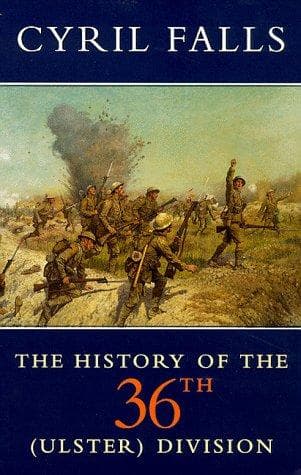
The History of the 36th (Ulster) DivisionFalls, Cyril
History
The History of the 36th (Ulster) Division
Falls, Cyril
Great Britain. Army. Division, 36th; World War, 1914-1918 -- Regimental histories -- Great Britain
It will be remembered that the Divisional Artillery, which had
come to France consisting of three 18-pounder and one 4.5 howitzer
Brigades, had been reorganized in May, the howitzer batteries being
divided among the other three Brigades. A second reorganization
took place in September, to a basis of six-gun instead of four-gun
batteries, though the howitzer batteries did not receive their
extra section of two guns till the New Year. The 154th Brigade was
broken up, and in February 1917 the 172nd Brigade became the 113th
Army Brigade, and left the Division. The details can best be shown
by a tabular statement which appears in the "Order of Battle."
Henceforth the Artillery consisted of two Brigades only, the 153rd
and the 173rd. A large number of Army Brigades were created by the
reorganization, and were used to increase the artillery at the
disposal of divisions for offensives or in dangerous sectors. The
change had some tactical advantages, but the lot of the new Army
Brigades, "nobody's children" as it were, and constantly moved from
one lively front to another, could not be described as happy.
[Illustration: VICTORIA CROSSES OF THE 36^{th} (Ulster)
DIVISION--1916.
The late Lt. G. St. G. S. CATHER
9^{th} Royal Irish Fusiliers.
The late Pte. W. F. M^cFADZEAN
14^{th} Royal Irish Rifles.
The late Capt. E. N. F. BELL
9^{th} Royal Inniskilling Fusiliers.
Pte. R. QUIGG
12^{th} Royal Irish Rifles.
The Late 2/Lt. J. S. EMERSON
9^{th} Royal Inniskilling Fusiliers.]
Public-domain text, read in full here on John Shaqi.
Reviews
Reviews
No reviews yet
Be the first to share your thoughts on this work.
Elsewhere in the archive
Join the Discussion
Join the discussion
Sign in to leave a comment or review.
Sign InorCreate an account