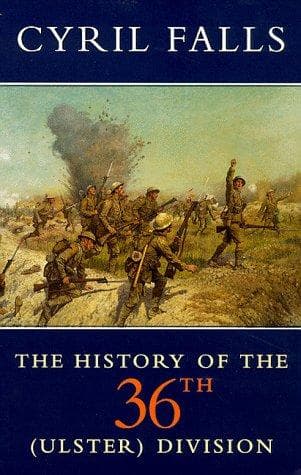
The History of the 36th (Ulster) DivisionFalls, Cyril
History
The History of the 36th (Ulster) Division
Falls, Cyril
Great Britain. Army. Division, 36th; World War, 1914-1918 -- Regimental histories -- Great Britain
The Division always worked hard, but there was probably no part of
the front in which it attempted and accomplished so much as here.
Just at first there was shortage of material, as there was of
ammunition, but the situation soon improved. By the labours of the
Pioneers and Infantry, working under the supervision of the three
Field Companies, the whole trench system was transformed. Parapets
were built stout and strong; parados, where none had been before,
appeared to match them. The communication trenches were strengthened
and improved by the famous "A" frame, the greatest single blessing
that authority provided for troops in Flanders. The deepening of the
bed of the Douve, and the removal of obstructions by the Engineers,
did much to lessen the winter floods. Trench tramways were laid, good
shelters constructed, reinforced concrete being largely employed.
Of these the most interesting was the battalion headquarters at La
Plus Douve Farm.[29] As one approached the place, one saw no sign of
human occupation, nor of its possibility. There was nothing but a
huge roofless farm, built round three sides of a square, as is common
in Flanders. But inside one of the wings was an unobtrusive concrete
structure thirty feet long, wherein the commanding officer and his
staff dwelt in great comfort, above ground, with ample head-room,
real windows, and protection from "five-nines." The courtyard
remained as it had been when the farm was finally destroyed by
bombardment eighteen months before, and its smashed reaping-machine,
half a bicycle, and old umbrella, seemed to have grouped themselves
after a Bairnsfather drawing.
Mention must here be made of the remarkable underground barracks,
made on the southern slopes of Hill 63 by the Australian Tunnelling
Company, to which the troops of the Division acted as carriers.
Driven into the steep flank of the hill, it was proof against any
artillery, lit all through by electric light, and capable of holding
two battalions at a pinch. There its charm ended, for it must be
confessed that it was damp, close, and malodorous, and that it was
impossible to leave a battalion long in it without ill effects upon
its health.
Public-domain text, read in full here on John Shaqi.
Reviews
Reviews
No reviews yet
Be the first to share your thoughts on this work.
Elsewhere in the archive
Join the Discussion
Join the discussion
Sign in to leave a comment or review.
Sign InorCreate an account