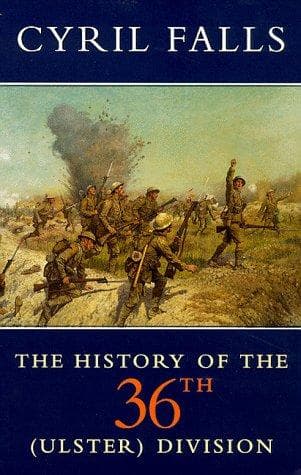
The History of the 36th (Ulster) DivisionFalls, Cyril
History
The History of the 36th (Ulster) Division
Falls, Cyril
Great Britain. Army. Division, 36th; World War, 1914-1918 -- Regimental histories -- Great Britain
It is no rightful part of the historian of a Division in the Great
War to embark upon preliminary sketches of the state of Europe
or of the movements in international politics that preceded the
catastrophe. If once he begin to seek for causes he must seek far.
Three pistol shots fired in the narrow streets of Serajevo may be
likened to an accidental spark that explodes a great charge. But the
charge was long laid. War had been determined upon in Berlin. Without
that accidental spark, there can be no doubt that it would shortly
have been deliberately exploded by a detonator from that quarter. If
the divisional historian cannot trace the laying of the charge, which
had been accumulating, it may be a hundred, and certainly fifty,
years, let him not begin by dealing with what were merely the final
accretions. Let him begin with the beginning of the war. War was
declared between this country and Germany on the 4th of August, 1914.
There are, however, certain local circumstances anterior to that
declaration, which have an intimate connection with the particular
Division that is the subject of this History, and so could not be
omitted without robbing the latter of much of its significance. The
Ulster Division was not created in a day. The roots from which it
sprang went back into the troubled period before the war. Its life
was a continuance of the life of an earlier legion, a legion of
civilians banded together to protect themselves from the consequences
of legislation which they believed would affect adversely their
rights and privileges as citizens of the United Kingdom--the Ulster
Volunteer Force.
The Ulster Volunteer Force, or U.V.F., as it soon came to be known
the world around, was the creation of Sir Edward Carson.[1] He
believed that if the Imperial Parliament were to persist in its
declared intention of forcing the Protestant population of Ulster
into an Irish Parliament, without its consent, the inevitable
consequence would be civil war in Ireland. Unorganized resistance
would be ineffective, and would beyond doubt lead to disorder and
unnecessary bloodshed. That the attempt would be made appeared
certain. The fate of the Government was bound up with its Home Rule
Bill. A failure to carry it through would have involved instant
defeat in the House of Commons, wherein the Irish Nationalist
Party held the balance of power. All the signs pointed to a clash.
It appeared to Sir Edward Carson that the surest defence of the
political ideals of his followers lay in convincing the people of
Great Britain that Protestant Ulster would fight for the preservation
of liberties and traditions which it held dear, which, in its eyes,
were now menaced. It was in this faith that he gave his approval to
the formation of the U.V.F.
Public-domain text, read in full here on John Shaqi.
Reviews
Reviews
No reviews yet
Be the first to share your thoughts on this work.
Join the Discussion
Join the discussion
Sign in to leave a comment or review.
Sign InorCreate an account