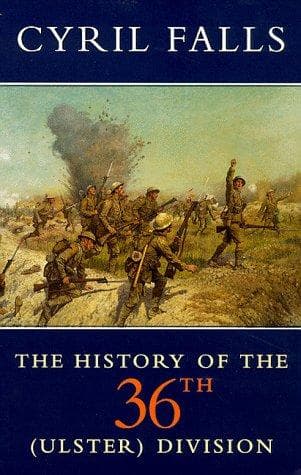
The History of the 36th (Ulster) DivisionFalls, Cyril
History
The History of the 36th (Ulster) Division
Falls, Cyril
Great Britain. Army. Division, 36th; World War, 1914-1918 -- Regimental histories -- Great Britain
Then, with one monstrous roar, every British gun upon ten miles
of front opened fire. At the same time the great semi-circle of
mines exploded, spewing up, as it seemed, the solid earth, of
which fragments fell half a mile away, and sending to the skies
great towers of crimson flame, that hung a moment ere they were
choked by the clouds of dense black smoke which followed them from
their caverns. There came first one ghastly flash of light, then
a shuddering of earth thus outraged, then the thunder-clap. That
opening uproar was heard quite distinctly in England. General Nugent,
returning to his command post on Kemmel from the observation post a
hundred yards away, declared that the sight he had seen was "a vision
of hell."
Amid a gloom still thick and intensified by a smother of dust, the
first wave of the infantry sprang from its trenches and went forward.
The second followed at twenty-five yards' interval to avoid the
German barrage. One of the mines was fifteen seconds late. Curiously
enough, it was the doubtful one at Spanbroekmolen. The infantry had
obeyed instructions and had not waited for it. A few of the leading
men of the 14th Rifles, out in "No Man's Land," were thrown off their
feet by the force of the explosion. But there were no casualties,
and the men quickly closed in to the barrage. The size of the
craters to be skirted and the darkness made the keeping of direction
a matter of difficulty. It would have been impossible but for the
use of compasses by the platoon commanders. There was considerable
overlapping by the troops of the Division on our right, at least
two companies of which swung across our front. The body of one of
their officers was subsequently found in the bed of the Steenebeek,
at L'Enfer Wood, over two hundred yards within the 36th Division's
boundary.
There was no resistance by the enemy in his front or support
trenches. Dazed and disorganized by the mines and the tremendous
weight of artillery, the few survivors surrendered. Two machine-guns
only, firing through our barrage, are recorded to have come into
action at this stage, on the front of the 109th Brigade. They came
into the open when it had passed, on the extreme left flank, and
were put out of action, one by a section of rifle grenadiers, the
other by a Lewis gun of the 11th Inniskillings. The enemy's barrage
was unaccountably light and ragged, even when the violence of our
counter-battery fire is considered, and fell upon the British
front line. The assaulting troops went straight forward to the
Red Line, close upon the barrage, leaving to the "moppers up" the
task of taking prisoners. It was reached at Zero plus 35; that is,
at 3-45 a.m. Here there was a halt in the barrage of a quarter of
an hour, and here the third and fourth company of each battalion
"leap-frogged" the first and second for the assault of the Blue Line.
The serious business of the attack was but beginning.
Public-domain text, read in full here on John Shaqi.
Reviews
Reviews
No reviews yet
Be the first to share your thoughts on this work.
Elsewhere in the archive
Join the Discussion
Join the discussion
Sign in to leave a comment or review.
Sign InorCreate an account