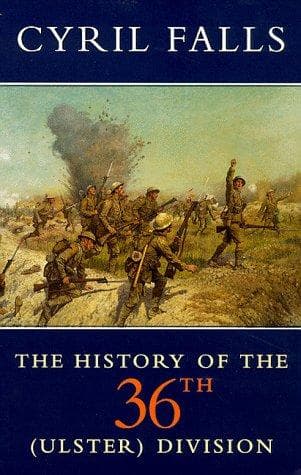
The History of the 36th (Ulster) DivisionFalls, Cyril
History
The History of the 36th (Ulster) Division
Falls, Cyril
Great Britain. Army. Division, 36th; World War, 1914-1918 -- Regimental histories -- Great Britain
The reader must strive to imagine the emotions of the men who waited
in the dark for the fateful moment. Some, the luckier ones, those of
the battalions and attached troops that were to take the Blue Line,
had but another forty minutes, though those forty minutes must have
seemed long enough. The battalions which were to pass through them
on that objective had two hours after that. It was eleven months
since the Division had made its first great attack. Despite its heavy
losses on that day and since, there was here a large proportion
of officers and men who had taken part in it, including many who
had then been wounded. They must have recalled, as they waited for
the crash of opening artillery, with what high hopes they had gone
forward on the banks of the Ancre. The task must have appeared to
them almost equally formidable to-day. And yet there was a general
feeling of confidence, and confidence not unreasoned. The British
Army had learnt much since then, and the men in the line realized the
growth of that knowledge and had their part in it. They had watched
the stage prepared for the triumphant _dénouement_, prepared with
matchless industry and forethought, and they were ready to play their
part fitly when the curtain rose. There was among the men, it may
be, less of that spirit of gay, generous, headlong valour, ready to
spill itself without a thought of the cost, but there was a greater
store of the soldier's craft; the craft which seeks to save itself
that it may inflict the more loss upon the opponent. In fighting
efficiency the Division, war-tried, but not war-weary, was probably,
in the small hours of that June morning, at the highest pitch it ever
attained.
Zero was at 3-10 a.m. It had been fixed, after long consultation with
Divisions, by the Army as the hour at which men should be able to see
just one hundred yards ahead. In the conferences after the battle the
general opinion seemed to be that it had been put five or ten minutes
too early. It had been arranged that a normal programme of harassing
fire should be carried out, as a cessation of this would have
appeared suspicious to the enemy. It seemed, nevertheless, to those
who watched and waited, that the night was unusually quiet. A few of
our howitzers spoke now and again, and from the German lines came
regularly the hiccoughing double thud of their great gun, followed by
the whine of its missile overhead, on its course to some objective as
far back as Hazebrouck.
Public-domain text, read in full here on John Shaqi.
Reviews
Reviews
No reviews yet
Be the first to share your thoughts on this work.
Elsewhere in the archive
Join the Discussion
Join the discussion
Sign in to leave a comment or review.
Sign InorCreate an account