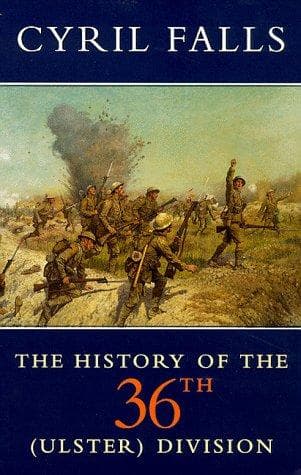
The History of the 36th (Ulster) DivisionFalls, Cyril
History
The History of the 36th (Ulster) Division
Falls, Cyril
Great Britain. Army. Division, 36th; World War, 1914-1918 -- Regimental histories -- Great Britain
The heat was now very great and the stench round Wytschaete from the
many horses that had been killed by our bombardments of the past week
was almost overwhelming. The troops were suffering from fatigue. It
was the hour at which reaction from the strain he has endured, and
the high pitch to which he has keyed himself, begins to creep upon
all but the very strongest of men. They solaced themselves during
the intervals of digging and wiring with the doubtful joys of German
ration cigars, found in great quantities in some of the dug-outs. The
Germans had begun to shell Messines and Wytschaete heavily.
The hour of the "New Zero"--that is, for the passing through of the
troops of the 11th Division--had been fixed meanwhile at 3-10 p.m. At
12-20 p.m. came an order from the IX. Corps that the Mauve Line was
to be held in force and consolidated, so that a good second line of
defence should be prepared by the time the 11th Division had captured
the Oosttaverne Line. Each Brigade was accordingly instructed to
garrison the Mauve Line with a battalion. Each Brigadier decided
to use the attached battalion of the 108th Brigade which had been
employed for "mopping up," and so was fresher than his other
battalions. Before three o'clock the 12th and 11th Rifles were upon
the Mauve Line, and at work putting it into a state of defence.
Punctually at 3-10 p.m. the 34th Brigade of the 11th Division moved
through the Mauve Line, behind a splendid barrage and with four
tanks. Though less artillery was firing, the barrage was even thicker
than had been that of the 36th Division, owing to the frontage having
been reduced to less than one half. It reached its objective, the
Oosttaverne Line, but was subjected to intense bombardment from the
German artillery, now all east of the Canal. The IX. Corps Cavalry
went through at 6 p.m.--too late, even if it had ever had a chance.
It suffered casualties from machine-gun fire, and could make little
or no progress.
The 16th Rifles (Pioneers) had attacked their heavy task of
road-making. Bridges for the trenches had been prepared and were
set in position. Shell-holes were hastily filled. With such a will
did the two companies on the road work, that before dusk wheeled
transport could move on the Lindenhoek-Messines Road beyond the great
crater in the Spanbroek salient. Another company cleared tracks for
pack transport up to the Black Line, marking them out with white
stakes and notice-boards. After the taking of the Oosttaverne Line
the battalion turned its attention to the top of the ridge, clearing
old communication trenches and cutting new ones. The 122nd Field
Company put up a fine obstacle along the whole length of the Black
Line, using, for the most part, German wire. This task was completed
by 3 a.m. on June the 8th.
Public-domain text, read in full here on John Shaqi.
Reviews
Reviews
No reviews yet
Be the first to share your thoughts on this work.
Elsewhere in the archive
Join the Discussion
Join the discussion
Sign in to leave a comment or review.
Sign InorCreate an account