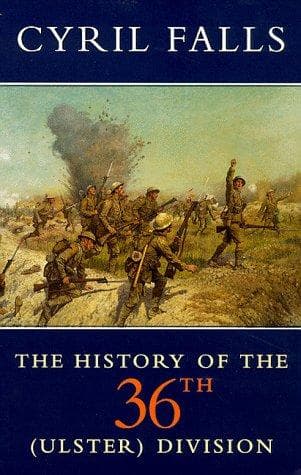
The History of the 36th (Ulster) DivisionFalls, Cyril
History
The History of the 36th (Ulster) Division
Falls, Cyril
Great Britain. Army. Division, 36th; World War, 1914-1918 -- Regimental histories -- Great Britain
The holding of a new-won position after a great attack was always
an unpleasant task. In this case the conditions were, from some
points of view, more difficult than those of the capture of the
ridge. "Jerry was angry," said the men, with justice. The Germans
now had a mass of heavy artillery behind the Canal d'Ypres, and
day and night they shelled the British forward positions and the
western slope of the ridge. On their second day in the line the
Headquarters of the 109th Brigade in the Grand Bois were so heavily
bombarded that General Nugent decided they should be withdrawn to
a company headquarters in our old lines. The troops in the front
trenches were on a forward slope, very exposed to observation, and
suffered heavily. At night ration parties on the roads had many
evil experiences. Casualties rarely amounted to less than a hundred
for the period of twenty-four hours, and several battalions had
considerably greater losses in ten days of this experience than in
the period from the 7th to the 9th of June.
Nor was it alone upon areas over which he had observation from the
ground that the enemy was able to bring to bear accurate fire.
Parties on railway work, lorries on the Wytschaete Road, suffered
very heavily also. The reason was that the situation in the air had
altered. British supremacy there had been absolute. Not a German
aeroplane had been seen during the battle. Since then certain of our
squadrons had moved north to the Salient. The German air force, on
the contrary, had been heavily reinforced. In particular the famous
Richthofen, with a squadron of very fast single-seater scouts,
painted bright red, raged up and down the front, catching many of
our comparatively slow photographic and artillery aeroplanes, and
shooting them down. Another favourite device of his was to sweep
low over our trenches, firing belt after belt upon the infantry in
them, who retorted, without much effect, by the fire of machine-guns
on anti-aircraft mountings. But his most spectacular feat was
undoubtedly the burning of our balloons. Of these there was a great
number on the front. From Kemmel about fourteen could be counted,
stretching almost to the coast on one side, and perhaps to Estaires
on the other. For men in the neighbourhood of the hill it became one
of the interests of those sunny afternoons to watch the balloons. The
programme was always of a similar nature. There would be a sudden
uproar of anti-aircraft fire, a fast-moving dot would approach one of
the balloons, two silver dots below the latter would represent the
observers making their way earthwards in their parachutes. A tiny
flicker of fire would appear atop of the balloon, swiftly growing and
spreading. Within a few seconds the flaming mass would sink slowly.
Sometimes the aggressor would dart straight off to the next balloon
in the line, and repeat the process with that. On the afternoon of
June the 23rd, three balloons in succession were brought down by one
aeroplane.
Public-domain text, read in full here on John Shaqi.
Reviews
Reviews
No reviews yet
Be the first to share your thoughts on this work.
Elsewhere in the archive
Join the Discussion
Join the discussion
Sign in to leave a comment or review.
Sign InorCreate an account