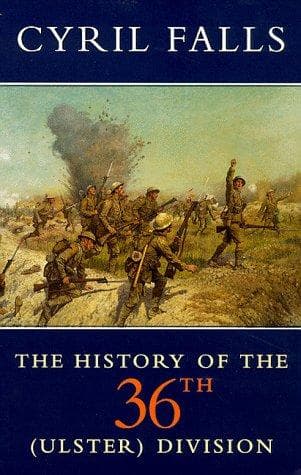
The History of the 36th (Ulster) DivisionFalls, Cyril
History
The History of the 36th (Ulster) Division
Falls, Cyril
Great Britain. Army. Division, 36th; World War, 1914-1918 -- Regimental histories -- Great Britain
The Germans meant to hold the ridge if they could. It was a valuable
position that had cost them dear in the winning. They knew an
attack was coming, but they put it one or two days later than it
was delivered. The Higher Command was well aware that the troops
in the trenches were in no fit state to meet it, after days of
terrific pounding, heavy losses, and shortage of food. It was in the
act of relieving them when the attack was launched. The relief of
one Division was incomplete when the mines went up and the British
bayonets came in the dark upon the columns in the communication
trenches. The confusion must have been indescribable. Again, the
German position, admirable for trench warfare, had weaknesses in
such a battle as this. It was a sharp salient, with a semi-circle of
artillery about it. The artillery had excellent observation. Had the
weather been misty, Kemmel would have been of little avail, and the
work of destruction comparatively ineffective. But the atmosphere was
wonderfully clear. The British fire upon the forts was overwhelming.
The counter-battery work was the best accomplished in the war. An
average of one gun to every German battery in action was destroyed
by our fire, according to the evidence of captured artillerymen.
The loss in horses alone constituted a severe blow. As to the
counter-attack, which was made in the afternoon with the 7th and
probably regiments of the 24th Divisions, it was launched late, and
met the full weight of our barrage. With its failure the High Command
appears to have decided, wisely no doubt, to abandon the struggle,
and made all haste to get every gun left to it east of the Canal
d'Ypres. It must have appeared to it that the position held by the
British offered doubtful results to a counter-attack in force. The
latter had now all the best of the ground, and a great counter-attack
upon the re-entrant held by them would have required more troops than
the enemy probably had available.
On the 13th of July the 36th Division, less its Artillery, which
remained in position, moved to the area between Mont Noir and
Bailleul. A certain amount of rest was obtained, but large parties
of infantry had to work under the Chief Engineer of the IX. Corps.
However, better things were in prospect, the Division being under
orders to move back to Merris. These orders were suddenly cancelled.
On the night of the 19th, the 107th Brigade on the right, and the
109th on the left, took over from the 11th Division the whole front
now held by the IX. Corps, from the Blauwepoortbeek at Deconinck
Farm, just north of the village of Gapaard, on the right, to Rose
Wood, north of the Roozebeek, on the left. The length of the front
was about three thousand yards. The Headquarters of the 107th Brigade
were established in a company headquarters of our old trenches, those
of the 109th Brigade in enemy dug-outs in the northern part of Grand
Bois. On the 20th, 36th Divisional Headquarters opened at Ulster Camp.
Public-domain text, read in full here on John Shaqi.
Reviews
Reviews
No reviews yet
Be the first to share your thoughts on this work.
Elsewhere in the archive
Join the Discussion
Join the discussion
Sign in to leave a comment or review.
Sign InorCreate an account