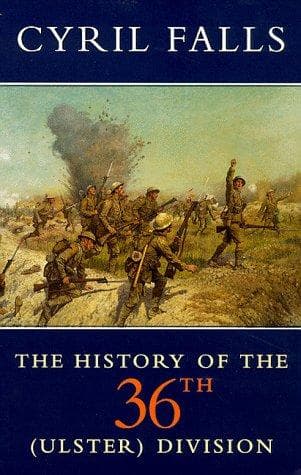
The History of the 36th (Ulster) DivisionFalls, Cyril
History
The History of the 36th (Ulster) Division
Falls, Cyril
Great Britain. Army. Division, 36th; World War, 1914-1918 -- Regimental histories -- Great Britain
The Division moved up at the end of July in huge brigade convoys of
'buses and lorries, and by the 30th was in the back area of the XIX.
Corps, between Watou and Poperinghe. Headquarters were established
temporarily in the latter town at two houses in the rue d'Ypres. The
following morning began the terrible struggle which is generally
known as the third Battle of Ypres.[37]
The great attack launched that morning was the second stroke of a
campaign which had begun triumphantly at Messines. The plans made
for 1917 by the Allied Command had been thrown into some confusion by
the retirement of the German armies on the Somme to their Hindenburg
system, in March, and later by the stopping of General Nivelle's
great offensive in Champagne.[38] The British had certainly played
their part at Arras and Messines. The British Command could obviously
now not count upon another great French offensive for some little
while, and it was under the vital necessity of keeping the German
armies heavily engaged. Its greater object was to strike at the
Belgian coast, where the submarine bases of Ostend and Zeebrugge were
becoming a menace so serious to the very existence of the nation.
That scheme has not been made public, and its details can be no
more than a matter of surmise to any but those in the confidence
of the British Command, or the Imperial General Staff. It will not
be discussed here. It is known, however, pretty generally, that it
involved an attack upon the coast-line and a landing. Camps had been
formed near Dunkirk, surrounded by barbed wire, where divisions were
to be assembled in greatest secrecy. And as for the attack in the
Salient, a glance at a railway map will show how serious an advance
across the Passchendaele Ridge upon Roulers would have been to the
German communications. A threat to the next great railway, the main
Brussels line between Ghent and Bruges, would probably have led to
the abandonment of the coast by the enemy. Ludendorff, in mid-July,
while the 36th Division was enjoying its repose in peaceful country,
had made one move in the game--no more than the move of a pawn in
such a struggle, but a clever and effective one. At Lombartzyde,
outside Nieuport, he had launched an attack against our troops upon
the little slice of ground held by them north of the Yser Canal,
driving them back into the river. Two divisions had very serious
losses, including over a thousand prisoners, and, worst of all,
the "jumping-off" ground for an attack on the coast line had been
snatched away.
Public-domain text, read in full here on John Shaqi.
Reviews
Reviews
No reviews yet
Be the first to share your thoughts on this work.
Elsewhere in the archive
Join the Discussion
Join the discussion
Sign in to leave a comment or review.
Sign InorCreate an account