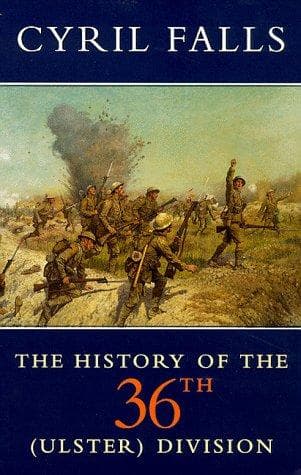
The History of the 36th (Ulster) DivisionFalls, Cyril
History
The History of the 36th (Ulster) Division
Falls, Cyril
Great Britain. Army. Division, 36th; World War, 1914-1918 -- Regimental histories -- Great Britain
Even if they failed in the ambitious venture, the British could at
least hope, beside continuing their policy of striking blow upon
blow at the enemy, to make an end of the accursed Ypres Salient, and
drive the Germans from the dominating semicircle of higher ground
from which they had so long harassed our troops. Half of this task
had indeed been accomplished by the Battle of Messines. The southern
curve of the Salient had almost disappeared. It remained to cut away
the northern. The great part of the fighting of Ypres, 1917, was to
take place north of the Zonnebeke Road.
The attack launched on July the 31st by the Fifth Army of General
Gough, and the First French Army of General Anthoine on his left, met
with a considerable measure of success. At its outset, indeed, the
success appeared complete; but the Germans, holding their positions
lightly and in depth, with the local counter-attack as one of the
main weapons of defence, retook much of the ground won. The Pilkem
spur was, however, in our hands. Great as had been our losses, the
attack upon a position of tremendous strength had gone well enough
for a beginning. But the weather, so pitiless on the Somme, that
had almost startled pessimists by its unwonted mercy at Messines,
broke that very day. Ere afternoon was over rain began to fall in
torrents. By the following morning the ground, ploughed up by weeks
of shell-fire, was a sea of mud.
The 55th Division, in the fate of which the 36th Division was
particularly interested, since its artillery was supporting the
attack, and its other arms were to relieve their Lancashire comrades
in that sector at a later date, had fared as well as any other. The
troops had gone forward with great dash and had almost everywhere
reached their final objective, known as the Green Line, east and just
south of St. Julien. The leading battalions had, however, suffered
very heavy loss from the fire of German machine-guns, distributed
in depth, and had not been sufficiently strong to resist the
counter-attack when it came. They were driven in upon the second
objective, or Black Line, which followed, roughly speaking, the line
of the road running south-east from St. Julien to the farm known as
Pommern Castle, in the Pommern Redoubt.[39] It was an advance of
fifteen hundred yards. To the south affairs had gone less well, and
the Black Line remained to be taken.
Public-domain text, read in full here on John Shaqi.
Reviews
Reviews
No reviews yet
Be the first to share your thoughts on this work.
Elsewhere in the archive
Join the Discussion
Join the discussion
Sign in to leave a comment or review.
Sign InorCreate an account