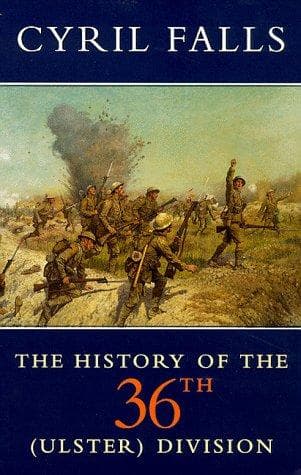
The History of the 36th (Ulster) DivisionFalls, Cyril
History
The History of the 36th (Ulster) Division
Falls, Cyril
Great Britain. Army. Division, 36th; World War, 1914-1918 -- Regimental histories -- Great Britain
That night two battalions of the 108th Brigade, the 13th Rifles and
9th Irish Fusiliers, relieved the 165th Brigade, which had moved back
to the old British front and support lines; and two battalions of
the 109th Brigade, the 11th Inniskillings and 14th Rifles, the 166th
Brigade; the whole force under the command of General Withycombe,
G.O.C. 107th Brigade, who had his headquarters in the great mined
dug-outs at Wieltje. Divisional Headquarters were established at
Mersey Camp, north of the Poperinghe-Ypres Road, and about mid-way
between the two towns, taking over command at 4 a.m. on August the
4th. On taking over the line from the 55th Division, General Nugent
decided that, in view of the dreadful conditions, it might be held
more lightly, and withdrew two of the supporting battalions to camps
about Brandhoek and Vlamertinghe, replacing them by companies of the
supporting battalions of the 107th Brigade. There were other reliefs
during the period of waiting, all the battalions having a turn,
though the six which were to lead over on August the 16th were saved
as much as might be. The headquarters of the Brigades also took turn
about in command of the line, in the filth and stenches of Wieltje
dug-outs.
Wieltje dug-outs! Who that saw it will forget that abominable mine,
with its "town major," its thirteen entrances, the water that flowed
down its main passages and poured down its walls, its electric light
gleaming dully through steam-coated lamps, its sickly atmosphere,
its smells, its huge population of men--and of rats? From behind
sack-curtained doorways the coughing and groaning of men in uneasy
slumber mingled with the click of typewriters. In the corridor one
would fall over a runner, slimy from head to foot with mud, resting
while he waited for a return message to the front line. One advantage
only it had: it was safe within. And that was in part counterbalanced
by the danger of exit and entrance, constantly menaced by storms of
fire. The cross-country tracks, simply paths from which wire had
been cleared, behind it, were more horrible still. Their object was
to allow troops and pack animals--even the shells for the field
artillery had to go forward by pack--to avoid roads under constant
shell-fire. But the Germans now knew them every whit as well as the
roads, and shelled them all day with every calibre up to 8-inch
howitzers. No one who used them but had at some point to lie crouched
on his belly, watching huge columns of earth and water spout up with
the burst of the big shells. Horrors were not new, nor did the sight
of dead bodies affect men overmuch, but there was one vision upon one
of these tracks, the mangled remains of a complete party of artillery
carriers, six men and twelve horses, which burnt itself upon the
brains of those that saw it.
Public-domain text, read in full here on John Shaqi.
Reviews
Reviews
No reviews yet
Be the first to share your thoughts on this work.
Elsewhere in the archive
Join the Discussion
Join the discussion
Sign in to leave a comment or review.
Sign InorCreate an account