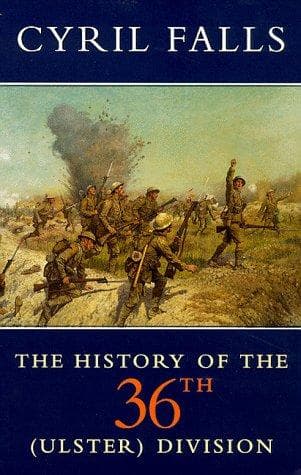
The History of the 36th (Ulster) DivisionFalls, Cyril
History
The History of the 36th (Ulster) Division
Falls, Cyril
Great Britain. Army. Division, 36th; World War, 1914-1918 -- Regimental histories -- Great Britain
It had been the intention of the Commander of the XIX. Corps to keep
the assaulting troops in line after they had made their attack,
till the eve of the next. The result of the Battle of Langemarck
was greatly affected by the fact that this resolution was not kept.
The 55th Division had suffered so greatly, and its infantry was
in a state of such fatigue, that it was decided to withdraw it at
once. The decision may have been inevitable; on that point the Corps
Commander, General Watts, was alone in a position to form a judgment.
For him and the 36th Division alike, it was disastrous. It meant that
for his next attack he had in his hands a Division jaded, weary,
shaken by deadly shell-fire, having lost a good third of its infantry
strength ere ever it left its trenches for the assault.
On the morning of August the 2nd, the 107th Brigade entrained at
Poperinghe and detrained at the famous Goldfish Château, west of
Ypres, coming under the orders of the 55th Division, to which
it had been allotted as a reserve. While his Brigade was on the
move, General Withycombe received orders from the 55th Division
for it to relieve the 164th Brigade in the old British front-line
trenches. The General reached Wieltje, the Headquarters of the 164th
Brigade, at 12-45 p.m. Three-quarters of an hour later he received a
telegram from the 55th Division ordering a further relief, that of
the much-depleted 165th and 166th Brigades in the captured German
positions. His men had a long march in heavy rain, and had not
completed the relief of the 164th Brigade till 3-40 p.m. The new
relief was entirely unexpected, and was not in accordance with the
intimation received by General Nugent that his troops were to be
used as a reserve. It was carried out in continuous rain, through
mud eighteen inches deep, under heavy fire from howitzers of heavy
calibre, and in the midst of bombing attacks launched against the
right flank of the 55th Division. Not till six o'clock on the morning
of August the 3rd was its completion announced. The Brigade had had
heavy casualties, particularly the 10th and 15th Rifles, which had
taken over the Black Line. After that night's work, in fact, there
could be no question of employing those battalions in the coming
attack.
Public-domain text, read in full here on John Shaqi.
Reviews
Reviews
No reviews yet
Be the first to share your thoughts on this work.
Elsewhere in the archive
Join the Discussion
Join the discussion
Sign in to leave a comment or review.
Sign InorCreate an account