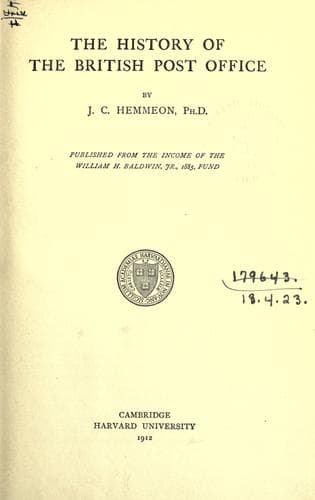
The History of the British Post OfficeHemmeon, Joseph Clarence
History
The History of the British Post Office
Hemmeon, Joseph Clarence
Postal service -- Great Britain -- History
At the beginning of the eighteenth century William Dummer entered into a
contract to supply packet boats for use between England and the West
Indies. For this service Dummer provided five boats, each one of 150
tons and carrying 50 men. Each was to make three round trips a year,
thus giving fifteen sailings every twelve months from both England and
the West Indies.[485] These boats were to make Falmouth their home port,
but they often kept on to Plymouth, probably because it was a better
place to dispose of their smuggled goods.[486] Poor Dummer was
exceedingly unfortunate with his West India boats. The first one to sail
was captured on her maiden trip. The receipts did not come up to his
expectations. He had supposed that to double the receipts he had only
to double the rates, but like other men before and after him he had to
learn the effect of higher rates on correspondence.[487] In 1706 he
wrote that it was a losing contract,[488] and in the same year the
Government released him from the agreement and paid him for two of his
lost packets.[489] From a total of fourteen boats provided for the
packet service, he had lost nine. The Postmasters-General recommended
that for the future the packets should leave and arrive at Bideford,
which was less exposed to the enemies' privateers than either Falmouth
or Plymouth.[490]
[485] _Cal. T. P._, 1702-07, p. 64.
[486] _Ibid._, p.57.
[487] Joyce, pp. 79, 81.
[488] _Cal. T. P._, 1702-07, p. 105.
[489] _Ibid._, 1702-07, p. 29.
[490] _Ibid._, 1708-14, p. 45.
Public-domain text, read in full here on John Shaqi.
Reviews
Reviews
No reviews yet
Be the first to share your thoughts on this work.
Elsewhere in the archive
Join the Discussion
Join the discussion
Sign in to leave a comment or review.
Sign InorCreate an account